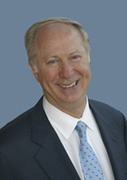
David Gergen, an advisor to four U.S. presidents and currently director of the Center for Public Leadership at Harvard’s John F. Kennedy School of Government, doesn’t care as much about who wins the U.S. presidential election in November as much as he does about whether “the winner can be an effective leader.”
The nominees, Republican Sen. John McCain and Democrat Sen. Barack Obama, each has strengths that he finds encouraging, and both have weaknesses that worry him, Gergen told his audience at the 12th annual Wharton Leadership Conference, sponsored by the Center for Leadership and Change Management, and the Center for Human Resources. For this election in particular, Gergen said, the winner must handle some of the roughest terrain — foreign and domestic — since Franklin D. Roosevelt in the early 1930s.
“In my judgment, the challenges facing the next president will be the most daunting facing any president of our lifetime. There have been immense problems building up for a long time and crying out for solutions, and time is not on our side,” Gergen said, adding that “context is important” when considering the leadership traits that we as a nation “ask of our presidents. You have to distinguish between the timeless qualities of leadership and the ones that are unique to the time.”
Gergen cited the example of Winston Churchill, who as British Prime Minister in 1939 was considered at the end of his political career. Yet by May of 1940, with the Nazis in France and British subjects expecting the German Luftwaffe to appear in the skies at any moment, the context of the prime minister’s leadership had changed profoundly. In the June 23, 2008 issue of Newsweek, Churchill was featured on the cover, with signature fedora, bow tie and cigar, against the backdrop of an American flag. The headline: “What Would Winston Do?” introduced an article that examined, among other things, the idea of appeasement, a term most recently used by Republicans in describing Obama’s stated willingness to talk without preconditions to America’s opponents.
“You feel a little like Gulliver in Lilliput,” Gergen said of the presidency. “Giant accomplishments are expected” although the reality is that presidents have less official power than they need. U.S. presidents cannot issue edicts from on high, although it may sometimes appear they have done just that. “There are all kinds of buttons you push,” Gergen added, but they somehow lead nowhere except out of the White House, into parts and offices unknown.
His observations on presidential power aside, “This is one of the most exciting campaigns in memory, one that has already reflected well on the country,” Gergen said, adding that he finds it striking how many people, in his travels abroad, approach him enthusiastically about the 2008 election. “This race has reminded [us] what’s best about this country. [We have a] diverse, dynamic, hard-to-understand, complex society. It’s that very complexity that presents challenges to any presidential candidate.”
Be Tough, Lead Tough
Gergen, advisor to presidents Richard M. Nixon, Gerald R. Ford, Ronald Reagan and Bill Clinton, thinks that a President Obama or a President McCain must possess and wield two essential characteristics: toughness and a consensus-building ability. “Transparency, accountability — all that and more are part of the 21st century menu” for a president, but a certain “inner steel” might often be urgently called upon, Gergen stated. “Part of it comes out of confidence, but another part comes out of, ‘Don’t mess with us.’ This is a world in which we need to work with more countries,” and unlike clearly delineated Cold War alliances, there are nations “that will lunge in the dark … unless they know they will pay a price for it…. I’m not sure if Obama has this yet.”
Gergen noted that another youthful president, John F. Kennedy, met Soviet Premier Nikita Khrushchev in Vienna, Austria for two days in June 1961. One result of the meeting, which Khrushchev dominated, was the eventual arrival of nuclear missiles in Cuba; later that summer Khrushchev authorized the construction of the Berlin Wall. Kennedy, however, proved his mettle during the 13 days of the Cuban Missile Crisis, Gergen added, when, in the famous words of Secretary of State Dean Rusk, “the other fellow just blinked.”
In Gergen’s opinion, McCain has proven that he’s tough enough, in the age of terrorism, to make adversaries blink — but perhaps too tough, given his recent indications of how he might handle Iran. The eagle on the presidential seal holds 13 arrows in one set of talons and an olive branch with 13 leaves in the other. The balance is important, Gergen said, expressing concern that the United States’ rendering of the rule of law is no longer considered unimpeachable around the world.
Red States, Blue States; Gray Nations
“We desperately need a consensus builder. On that issue, Obama has enormous capacity and potential. On that issue, I worry about McCain,” Gergen said.
Toughness must be coupled with “the capacity to build coalitions, not just here, but internationally,” he continued. “The rise of Asia is extraordinarily important.” Working with China and India on climate change is one example, to say nothing of trade. Unrest in the Muslim world, AIDS, disease and poverty are American concerns, too. Vision and good judgment for the U.S. is no longer enough for our next president — he must share it, as well as seek it out, around the world, according to Gergen.
McCain or Obama must develop strong cross-cultural capacities and international perspectives, Gergen said, because this new century is making new demands on leaders. But certain leadership traits are timeless. He noted that historians have a habit of naming these traits in threes, and he is no different. For Gergen, they come down to judgment, character and ambition, and examples of each can be seen in Nixon, Clinton and President George W. Bush.
Gergen, a graduate of Yale University and Harvard Law School, spent a year and a half in the Navy before joining the Nixon White House as a speechwriter. In the 1980s, he worked for presidents Gerald R. Ford and Ronald Reagan (and later Clinton), then became editor of U.S. News & World Report before joining the Kennedy School in 1999. He has published a best-selling book titled, Eyewitness to Power: The Essence of Leadership, Nixon to Clinton.
“This was a learning experience for me,” he said, touching on his transition from the U.S. Navy to life in Washington as a Nixon speechwriter. “I grew up in an academic family. I always thought intelligence and judgment were the best qualities. Boy, did I discover that was wrong.”
With Nixon, he learned that judgment cuts both ways, and on a national scale, it becomes a mighty sword. “He was, in many ways, one of the brightest working politicians of the 20th century, a true strategist,” Gergen said of Nixon. He could intuitively understand how the forces of history would work out over given periods of time. “He was one of the first to appreciate the fact that China and Russia were joined at the hip,” but that if you could “sever the Siamese twins,” in effect you would have a divide and conquer strategy, because the Soviets could not sustain themselves and China’s entrepreneurial spirit was becoming too evident.
Nixon’s trip to China, widely considered his foreign policy apogee, was to facilitate that divorce from Russia, Gergen said. Nixon and his advisers were “curious about the other [people’s] views — if you could figure that out, you could work out a bargain. He thought in those terms.” In the Middle East of today, he said Nixon would probably work to play Iran and Syria off one another.
“If that were all there was to Nixon, he would have been a great president, but there were demons within him he could not control,” Gergen said, citing Nixon’s “very, very dark side.” The man was genuinely “paranoid,” and had an “eat or be eaten” mindset. As for Watergate, Gergen could not say if the decision to break into Democratic headquarters was directly Nixon’s, but that it didn’t really matter. “I can guarantee you that the people who broke into Watergate thought that’s what he wanted. Leaders send out cues…. The challenge is self-understanding and self-control, so as not to let your dark side derail you.”
Character, another of the three timeless qualities, is what derailed Bill Clinton, according to Gergen. Clinton “had the most subtle mind of anybody I’ve ever known,” Gergen said, clarifying Clinton’s intellect as “capacious” and capable of “synthesizing” on two or three different fronts at once. He could carry on a conversation with the most articulate intellectuals on his staff or in his cabinet while doing the New York Times crossword puzzle.
“He exercised 360-degree leadership,” understanding the perspectives of not just his supporters, but also those with views antithetical to his, Gergen added. Constituencies who previously did not have a seat at the table — Hispanics, blacks, women — felt that they did with Clinton. “At home and overseas, he didn’t just talk to the powerful people. Many of his good decisions came out of that place.” Gergen didn’t comment on Clinton’s impeachment, but did note that “what he lacked so often was a true north. He lacked a moral compass.”
Gergen’s take on the importance of Nixon’s curiosity about China was prelude to a criticism of the current president. As for George W. Bush, he said, “I just assumed that by the time you come to office, you’ve got a lot of curiosity. Now we have a president who has, in fact, had his walk on the wild side — some would say it was an extended tour. What I had not fully comprehended was how uncurious he was.” Only if you’re curious can you act on your hunches about what is really important, Gergen said, and then only sparingly. “If you rely on hunches, especially ill-informed hunches, you can get into a lot of trouble.”
Leadership and ambition
The third leg of his triad of timeless qualities imperative for a president, ambition, is not well understood and often makes people uncomfortable, Gergen said. “I say that fully understanding that excessive ambition can very easily derail leaders.” It is where the ambition is aimed, he suggested, that makes the difference. “Great leaders become ambitious for others.” They seek “achievement of goals beyond the self. You need someone who has a vision for what America can be.”