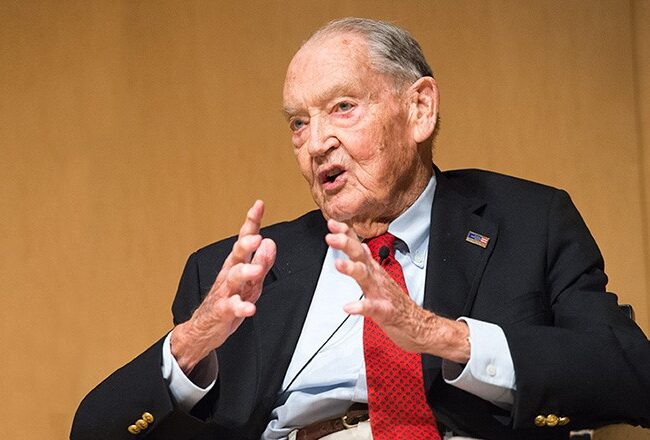
It would be no exaggeration to say that John Clifton Bogle — known as Jack — did more good for the individual investor than anyone else in the past century. As the investment world remembers his passing this week, the plain-spoken founder of mutual fund giant Vanguard was best known for his tireless advocacy for ultra-low-cost funds and long-term investing.
Called the father of indexing, Bogle created the first index fund based on the S&P 500 for individual investors and ushered in an era of low-cost investing that brought fees down for the entire industry. Throughout his life, Bogle fought for the small investor, not wavering in his belief that a low-fee portfolio buying all the securities in an index and held long term would outperform the average actively managed fund. And he was proven right.
Today, Vanguard is the largest mutual fund company in the world with $5.3 trillion under management on behalf of 20 million investors in 170 countries. Its average expense ratio, the annual cost paid for money management, is 0.11% compared with 0.52% for the industry average for funds and ETFs in 2017, according to Morningstar. Bogle, who founded Vanguard based on his investing principles, understood early on that high costs can undermine even the best performing fund.
In his 2017 annual letter to shareholders, Berkshire Hathaway Chairman and billionaire Warren Buffett wrote that if a statue were to be erected to honor someone who has done the most for American investors, “the hands down choice should be Jack Bogle.” Buffett noted that early on, Bogle was “frequently mocked by the investment-management industry. Today, however, he has the satisfaction of knowing that he helped millions of investors realize far better returns on their savings than they otherwise would have earned. He is a hero to them and to me.”
Bogle, who had attracted a horde of fans known as Bogleheads, was named in 2004 among the 25 most influential business leaders of the time by Knowledge at Wharton and the Nightly Business Report. Lessons from these leaders resulted in a book called Lasting Leadership. Bogle also discussed the stock market and corporate reform with Wharton finance professor Jeremy Siegel in a Knowledge at Wharton article two years earlier.
In 2003, while the country was at war, unemployment was up and the economy was teetering, Bogle gave this advice to investors: Stay the course. Don’t make decisions based on emotion. Stick to low-cost, buy-and-hold investing for the long run, according to an interview with Knowledge at Wharton. Sixteen years later, his timeless advice continues to hold up well.
Image: The Institute for Fiduciary Standard – http://www.thefiduciaryinstitute.org/, CC BY-SA 4.0, https://commons.wikimedia.org/w/index.php?curid=69018781