Most energy experts agree that global warming is a serious threat, and they also agree that green technology has the power to fundamentally reshape how business gets done. But at this early stage, these experts — including investors — are finding it hard to separate truth from exaggeration when it comes to the benefits that green technology can offer. That was the consensus of industry speakers at the recent Wharton Energy Conference who participated in panels on renewable energy, oil and gas, energy finance and power.
At the moment, an aura of uncertainty surrounds the electric-power industry, according to several panelists who noted that old-line players, like the investor-owned utilities, are cautiously awaiting signals from politicians, regulators and even the public. Companies want to know whether the United States will adopt a so-called “cap-and-trade”system to govern carbon emissions or a more straightforward carbon tax. In addition, they are wary of betting too heavily on any particular new technology, such as wind or solar, until they know that it will be broadly supported.
Yet at the same time, venture capitalists and new investors like Google are eagerly pouring money into just about any startup that brands itself as pursuing “clean tech” or renewable energy. As a result, technologies that remain unproven on a massive scale are seeing huge run-ups in value. Stock in U.S.-based First Solar, for example, has returned nearly 600% over the last 12 months.
“We are not in a bubble [for renewables], but there are valuation issues,” said Michael Liebreich, chief executive of New Energy Finance, an energy consultancy. “There is $100 billion of new money that has been invested in clean energy across all sectors and countries. What you have is enormous inflation of asset prices, which is driven by that liquidity, not by fundamentals. In the fear-and-greed balance of capitalism, we’re definitely in the greed phase.”
People are so giddy over solar power’s potential that they are making investments that simply don’t add up, Liebreich said. Germany, a country with relatively weak sun, has committed to producing electricity via solar. But solar power, which remains costly compared with traditional sources, works best in places with abundant sunshine and a weak transmission infrastructure for electricity, like Africa and much of Asia. Germany is “is papering over agricultural land with solar,” he said. “It’s absurd. You have a situation where 90% of the capacity of rapidly growing solar-cell manufacturing is going into Germany.”
Some solar proponents prefer to see shortcomings in the resource as manageable. Solar, for example, is intermittent — it only works when the sun is shining — and in some parts of the world produces far more power during the summer than the winter. Only what he called a “portfolio approach” that includes several sources of power — such as solar, wind and nuclear — will cover all of the world’s power demand while also stemming carbon emissions.
‘The Saudi Arabia of Wind’
Despite the importance of wind and nuclear power, both of those sectors face short-term obstacles, at least in the United States, conference panelists noted.
Consider wind, said Tim Rosenzweig, chief financial officer for UPC Wind in Boston. In many ways, it’s ideal for the United States, which has lots of open space and, in some regions, famously strong breezes. “The Dakotas have been called ‘The Saudi Arabia of Wind,'” he noted.
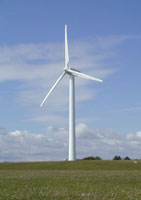
The trouble is, the best areas for situating wind turbines — the big bladed towers that look like aircraft propellers without the plane — and thus producing power are far from big cities. And at present, adequate infrastructure doesn’t exist to move the wind-generated electricity to the millions of people in the Chicago region, much less to people on the East and West coasts.
Yet putting the turbines closer to crowded urban corridors has proved thorny, he pointed out. Companies face the classic NIMBY (“Not in my Backyard”) dilemma. Many people like the idea of wind power but don’t want to look out their windows and see the turbines. Cape Wind, a wind farm off Cape Cod that has been the subject of national media attention, is a prominent example of a project that has dealt with NIMBY issues. In the case of Cape Wind, organized residents — including Senator Ted Kennedy — lobbied against it on aesthetic grounds, among others. In light of this reality, “we are now looking at Northern Maine, potato country,” Rosenzweig said. “We are seeking opportunities where communities will embrace wind, and it can create [needed] jobs.”
Placing turbines even farther offshore than the Cape Wind Project — that is, out of sight — could sidestep the sort of opposition Kennedy and others had voiced. But at the moment, that’s not practical. “The technology isn’t ready for prime time,” Rosenzweig noted. “The cost to install offshore wind is very high; it’s much more expensive to maintain and the wind isn’t that much better.” The potential additional revenues simply don’t offset the costs.
In the short term, wind-power generators also face shortages of turbines. Most turbines are produced in Europe, which embraced wind power earlier than the U.S. With the current weakness of the U.S. dollar, they are too expensive to install here. “Turbine prices are up more than 60% over the last three years,” he said.
A $350 Billion Investment
Nuclear, for its part, is a workhorse technology, already providing about 20% of America’s electricity. (Nuclear reactors produce about 80% of the electricity in France.) But a U.S. utility hasn’t built a new nuclear power plant in decades due to high construction costs and public opposition. People grew wary of nuclear in the wake of the accidents at Three Mile Island, near Harrisburg, Pa., and Chernobyl in the Ukraine. No one was harmed when the core of the Three Mile Island reactor melted down in 1979, but hundreds died in 1986 after the Chernobyl plant exploded. The disaster spewed radiation throughout Europe and forced the resettlement of 400,000 people who lived nearby.
Today, a nuclear reactor still operates on Three Mile Island; it’s the sibling to the one that malfunctioned three decades ago. It is run by Chicago-based Exelon, the leading U.S. producer of nuclear power.
Because of the concerns about global warming, utilities are showing a renewed interest in constructing nuclear plants. They are beginning to submit applications for new facilities and seeking regulatory guidance on how to proceed. None of them wants to move too aggressively because of concerns about red tape, potential protests from the public, and thus escalating costs. “Cost overruns on nuclear plants almost bankrupted investor-owned utilities in the 1970s and 1980s,” pointed out Mac MacFarland, vice president for corporate development at Exelon.
Even so, companies are laying plans so that they will be ready to proceed with construction once they get the assurances they need. Exelon, for example, is preparing to file an application for a reactor in Texas, MacFarland noted. Assuming that it moves ahead, it would be a huge financial commitment, so much so that MacFarland wondered how many other companies could afford to follow his firm’s lead. “The equity component alone would be 6% of our market capitalization, and we’re the biggest company in the industry. We are twice as big as the next largest.”
Even without building new nuclear plants, the traditional power industry faces huge financial burdens. “There will need to be $350 billion invested in [power] generation over the next decade,” he said. “Transmission represents another $150 billion of needed investment — the distribution infrastructure in our cities has really deteriorated. Environmental retrofits on existing plants are going to cost another $50 billion, and that doesn’t include carbon capture. Efficiency investments are going to be another $50 billion.” For companies to carry these costs, they are going to have to bulk up by merging. “A consolidation will happen in the industry,” MacFarland predicted. “It has to.”
For the moment, many utilities are reluctant to move forward on any sort of big investment because of the lack of clarity on whether they will face a carbon tax or a cap-and-trade system, several conference panelists pointed out.
A cap-and-trade system limits the total emissions of a pollutant and then gives companies permits to release a certain amount (say, in this case, one ton of carbon per permit). Regulators then gradually reduce the number of permits, forcing companies to cut overall pollution. Meanwhile, firms can trade their permits. Efficient operators — those that don’t use up all of their emission permits — can sell their unused ones to less efficient firms. This creates an incentive for the efficient firms to keep pushing down their emissions (thus earning extra permits to sell) while allowing breathing room for less efficient outfits that can’t reach emissions targets. The less efficient players can weigh whether they should invest heavily in lowering their emissions or buy someone else’s excess permits. That lets the market decide where pollution cuts get made.
NOx and SOx
In 1990, under the Clean Air Act, the United States adopted a cap-and-trade system for power-plant emissions like nitrogen and sulfur oxides (NOx and SOx). “NOx and SOx have been reduced by 40%,” MacFarland said. “Market forces did that. You had a lot of low hanging fruit, and we were able to address those with scrubbers and low-NOx burners.”
The practical effect of a carbon tax or a cap-and-trade system is the same: Both create a financial incentive to clean up pollution. Politicians tend to prefer the cap-and-trade approach because it doesn’t involve levying a new tax, but, in either system, the costs will be passed on in the form of higher power prices. “A lot of people talk about cap-and-trade like it’s a solution to the dilemma that we find ourselves in,” said Jane Sadowsky of Evercore Partners, an investment banking firm. “But the costs of a cap-and-trade system will be borne by the consumer, too.”
Whichever method politicians choose, they need to do so soon, said Parker Weil, managing director for the Americas power group at Merrill Lynch. “The government’s mistake is that it’s not providing clear-cut price signals. Gas should be more expensive, and coal should be more expensive.”
Barney Rush, chief executive of H2Gen Innovations in Alexandria, Va., agreed, pointing out that, in some ways, a tax would level the playing field between dirty power sources, like coal and oil, and clean ones like solar, wind and — his company’s specialty — hydrogen. At present, some commentators criticize clean technologies because they depend on government subsidies. “I’d be happy to get rid of every single subsidy for renewable energy if we had a carbon tax that priced emissions at appropriate levels and then let the markets decide,” he said. “A broad, across-the-board way to say that there are costs to carbon emissions would be with a tax.”
That doesn’t mean that all renewable technologies would succeed; some might remain impractical for widespread use. Hydrogen, which Rush’s company is trying to exploit, has the advantage of being ubiquitous and usable in cars and trucks, he pointed out.
Rush noted the often-heard comment that “hydrogen has a reputation as being tomorrow’s technology — and it always will be.” A few years ago, it got a lot of buzz when U.S. automaker General Motors began to evangelize about its plans to make hydrogen-powered cars. But those plans have been slow to materialize, and that has soured some people on hydrogen’s potential. “In the last couple of years, people [haven’t wanted to] talk about hydrogen,” he said. It is true that “developing fuel-cell technology takes a long time and a lot of effort,” Rush noted, but the technology, in both transportation and industrial applications, continues to advance. Honda, for example, will begin leasing hydrogen-powered cars in California this year for $600 a month. And hydrogen-powered forklift trucks are already operating in some warehouses.
Rush argued that hydrogen cars must succeed. International trends — like the rapid development of India and China, with their combined populations of more than two billion people — leave little choice. “Within 20 or 30 years, the number of cars in China and India will be no different than what we expect here in America,” he added. “If you look ahead to that kind of demand, the fuel isn’t going to come from oil. It’s going to have to come from other sources.
“We aren’t going to transfer overnight to a carbon-free world,” Rush said, “but there will be a transformation over the next 20 to 30 years. There’s going to be a gradual lightening of carbon in the mix.”