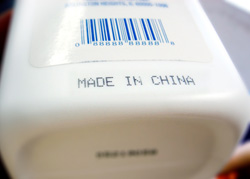
Numerous news stories this past month have focused on concerns about the quality and safety of certain Chinese exports. In this opinion piece, Paul Midler, founder and president of China Advantage, a services firm that provides outsourcing and supply chain management to U.S. and European companies, discusses what he calls “quality fade” in China, which he defines as “the deliberate and secretive habit of widening profit margins through a reduction in the quality of materials.”
Recent media reports detailing a series of quality problems with Chinese-made exports — pet food tainted with prohibited chemicals, toys covered with lead paint and tires that fall apart at high speed — have understandably alarmed the American public and resulted in a number of international product recalls. But supply chain professionals not directly affected by these recalls remain unusually calm. “Everything will be all right,” said one U.S. importer on a buying mission to China. “As the country continues to develop, the quality of its products will naturally rise.”
It’s the sort of comment that sounds logical, but is not necessarily true. Quality does not always rise over time, as China’s own history shows. At the end of the 19th century, the West rushed to buy China’s beautiful silk products. Demand quickly expanded, and new players moved into the market. As competition intensified, manufacturers began to cut corners on quality, and silk products out of China soon gained a reputation as inferior goods. By the beginning of the 20th century, traders were already looking elsewhere, and Japan, which had been building a reputation for delivering a more consistently high-quality product, became an attractive alternative. By 1930, Japan was exporting twice as much silk as China.
One of the problems facing China is that manufacturers continue to engage in a practice I call “quality fade.” This is the deliberate and secret habit of widening profit margins through a reduction in the quality of materials. Importers usually never notice what’s happening; downward changes are subtle but progressive. The initial production sample is fine, but with each successive production run, a bit more of the necessary inputs are missing.
What is maddening to importers is that quality fade often occurs in the last place an importer thinks to check. One American company had been importing a line of health and beauty care products for over a year when the cardboard boxes that held its product suddenly started collapsing under their own weight. There was no logical explanation for the collapse except quality fade, and the supplier in this case blamed sub-suppliers for replacing an acceptable cardboard box with ones that were inferior.
The Case of the Missing Aluminum
Some quality issues are not all that serious, but others are downright frightening. One of the most disturbing examples I have encountered while working in China involved the manufacture and importation of aluminum systems used to construct high-rise commercial buildings. These are the systems that support tons of concrete as it is being poured, and their general stability is critical. The American company that designed and patented the system engineered all key components. It knew exactly how much each part was supposed to weigh, and yet the level of engineering sophistication did not stop the supplier from making a unilateral decision to reduce the specifications. When the “production error” was caught, one aluminum part was found to be weighing less than 90% of its intended weight.
Where did the missing aluminum go? Into the factory owner’s pocket as a cost saving. The only thing passed on to the customer was an increase in product risk. Quality fade is like the straw that broke the camel’s back — only in reverse. Suppliers push the limit by taking more and more out of the equation until they are caught, or until disaster strikes.
Even when importers catch suppliers in a quality fade, they frequently don’t do much about it. Many quality problems are seen as too minor relative to the difficulties involved in rectifying them. Customers may not notice a product flaw, but they most certainly notice when a product is not delivered on time. The chance of a product failure is usually remote, but the penalty for late delivery is an almost certain loss of business.
Some importers bravely attempt to fight back against quality fade by insisting a supplier replace substandard goods at the factory’s expense. A savvy supplier — and most are extremely savvy — can respond to such demands by threatening to terminate the supplier relationship. Or the supplier can respond by raising prices. Importers might then say they will switch suppliers, but the factory owner knows this is an empty threat as finding and cultivating a new supplier can take a long time. And anyway, there is no guarantee that the next supplier won’t engage in the same willful behavior as the first.
The factory owner who practices quality fade knows exactly where he stands with his customer in these cat-and-mouse games. He has virtually nothing to lose and only margin to gain — and, having gotten away with it once, no one should be surprised when he goes for it again. When the factory owner offers his most sincere apologies and promises that it won’t happen a second time, importers simply close their eyes and hope for the best.
If Adam Smith were around today, he would have had to write a separate chapter on global outsourcing. Because it takes importers a long time to find suppliers and to get them up to speed, importers keep their suppliers a secret. The last thing that an importer wants to do is let his competitors know the source of any supply chain advantage he may have. Even when it is in their collective interest to share information, importers keep to themselves. As a result, factories pay little, if any, reputational cost for production shenanigans. The invisible hand doesn’t work well when the manufacturers themselves are unseen.
This lack of accountability also has legal implications. When a product is recalled in the U.S., the importer pays the cost of that recall. It remains next to impossible to take legal action in China, and only in the rarest case can an importer successfully sue the supplier responsible for a product failure. Since most suppliers are paid in full well before goods leave the factory, the importer doesn’t even enjoy the leverage that comes with owing payment to the supplier. The average importer has far less leverage than imagined.
Outwitting Third-party Testers
In the wake of quality problems, many are looking to third-party testing as a solution. In theory, testing works well. Prior to exporting a product, the supplier takes a sample and sends it off to a reputable and international testing laboratory, which then checks to make sure the product is safe. Unfortunately, testing doesn’t work well when a supplier sets out to circumvent the system.
I recently worked with one supplier that was encountering difficulties making a quality liquid soap for export to the U.S. To get around problems the supplier was having with laboratory results, the supplier created 10 random samples and sent them to the same lab for testing. Nine of these samples failed, but one passed. The supplier took the one test result marked “passed” and sent it off to the customer. The U.S. company never knew about the failed results, and a purchase order was promptly issued.
Third-party testing is far from fail-safe. Consider one study conducted by the U.S. Consumer Product Safety Commission in 2001. In a review of nearly 200 recalled electrical products from China, the CPSC found that more than 25% had had prior approval by an international third-party testing agency such as Underwriters Laboratories (UL), Intertek Testing Services (ETL) or the Canadian Standards Association (CSA).
Both the Wall Street Journal and the New York Times have suggested that the solution to China’s quality problems lies in greater vigilance on the part of importers, but the question remains: If professional third-party testing agencies are failing to catch product failures, how is the average importer expected to do so? After all, third-party testing agencies have far better resources, and their people are much better trained.
Private quality assurance programs may also be put in place, but suppliers can circumvent such controls as well. In one case, after a load of plywood was rejected at one factory, the supplier simply mixed a portion of it with product that was perfectly good in later shipments. Working the bad into the good is a common way for a factory to reduce loss. A supplier can bury sub-standard product knowing full well that warehouse workers in the U.S. do not have the time to examine each piece that comes in. And detailed contracts cannot succeed in bridging any moral gap. In order for supplier relationships to work successfully, there must be a basic level of trust.
Get Rich Quick
In an effort to reduce risk, American companies are also looking to suppliers that are larger and seem more capable. The unfortunate fact about China’s larger factories, however, is they charge more for product than smaller factories do. It is as if economies of scale do not apply in China. There are several reasons why China suffers from such a problem, and one has to do with the role government plays in manufacturing.
Where a small factory may have been funded entirely by the government, future expansions are more often privately financed. Making the matter worse are extremely short payback periods on private investment. Many factories hope to pay off investments in as few as three years. One of the worst things an importer can hear is, “We want to show you our most recent expansion.” The more a supplier invests, the quicker it raises prices.
There is a sense of urgency in China, the feeling that one must work fast before the window of opportunity closes. For factories, that means taking shortcuts on quality. Many factory owners can’t see beyond the next purchase order.
One reason for the short-sightedness may have to do with China’s political environment. The one-party government does what it wants, when it wants. And while there may be some advantages to a government that can operate without restraint or controversy, such a system limits predictability and leaves the business sector keenly aware that it is subject to the evanescent whims of officials who may or may not know which policy is best.
The U.S. administration has recently been applying pressure on China to revalue its currency in order to close the growing trade gap between the two countries. To appease the U.S., China has responded by reducing the tax rebates it offers to manufacturers. For some suppliers, the tax rebates have constituted a major portion of their bottom line. Massive and sudden changes such as these only confirm the factory owner’s paranoid suspicions that the manufacturing opportunity could disappear at any moment. No one in China is sure how long anything will last — a situation that keeps many focused on the immediate present.
Chinese manufacturers that engage in quality fade unfortunately subscribe to the view that business is about increasing one’s share of the pie rather than growing the pie over time. They often focus on extracting profit through short-term maneuvers that inevitably militate against long-term development. This approach, it should be noted, contrasts sharply with the success strategies of such economies as Japan and Korea, which focus on building market share and developing strategic relationships.
Playing It Short
Some blame quality problems and product recalls on the relentless pursuit of lower prices. Importers most often go to the cheapest supplier, so the supplier who quotes low and quietly cuts corners on quality is the one who wins. Honest suppliers who prefer to quote higher and offer a better quality product lose out. The supplier who obfuscates catches orders first — and most often.
Chinese suppliers are excellent at playing the short game. When an importer discovers a quality problem late, the factory turns around and suggests, “But you signed off on the original production sample yourselves.” When goods arrive damaged in the U.S., the factory claims that the importer has been making up the story in order to lower import costs. Arguments like these work in the short term. Over the longer term, however, importers get wise, and alternative markets start to look increasingly attractive.
China’s quality situation is by no means hopeless. Japan was known decades ago for making inferior products, but that changed. The key to turning the situation around is to incorporate a habit of quality into the culture. China, however, has not shown that it has any interest in doing so. Recent accusations of unreliability in Chinese products are now being met with tit-for-tat claims that U.S. products are faulty. This is an unfortunate strategy for China, and it means that we will continue to see quality problems. China will not be able to succeed so long as manufacturers are competing in a race to the bottom.
Paul Midler has been involved with China for more than 15 years, and in the course of his manufacturing career, has had dealings with thousands of Chinese factories. He is also a writer and occasional speaker on China.