Across the world, organizations by and large subscribe to the typical 9-to-5 workday. But what if that formula for work is creating an environment of decreased efficiencies, lowered innovation, and a creativity deficit? A collaboration between the Wharton Neuroscience Initiative and Slalom, a global business and technology consulting firm, explores how aligning work with individuals’ biological rhythms — their “chronotype” — can unlock creativity, improve performance, and lay the foundation for building more adaptive organizations.
Chronotype, an individual’s natural timing system for sleep and alertness, varies widely from person to person. Though often discussed in the context of sleep, chronotype powerfully influences our waking hours: when we think clearly, when we hit a slump, and when we’re at our creative best. These differences are rooted in our neurobiology, shaped by genetics, lifestyle, and even age. And these differences have measurable effects on cognitive performance.
“This isn’t about preference or discipline,” says Elizabeth (Zab) Johnson, executive director of the Wharton Neuroscience Initiative. “Our daily alertness is shaped by two interacting biological forces: the buildup of sleep pressure over time and our circadian rhythm, the brain’s internal timing system. The way these systems intersect determines when each of us is naturally primed for focus, creativity, or recovery. That’s chronotype.”
Biological Timing May Be One of the Most Overlooked Drivers of Workplace Performance
As companies debate how many days a week employees should return to the office, whether hybrid models are sustainable, and how AI impacts how and when employees do their work, a deeper question remains largely unasked: When are people biologically wired to do their best work?
Most organizations are built around a simple assumption: that everyone should be ready to work and perform at their best at roughly the same time. While the standard 9-to-5 schedule has long been the default, it assumes everyone’s brain operates on the same clock. Beyond typical office hours, an estimated 16% of U.S. workers have non-standard schedules outside the regular 9-to-5, including those in health care, transportation, hospitality, and manufacturing. Acknowledging this complexity adds important context to the conversation: Aligning work with our natural rhythms isn’t just about boosting productivity, it’s about understanding the realities of how and when people work. As Amalia Goodwin, Slalom’s global leader for workplace transformation, says, “Organizations work best when they’re designed around how people actually work.”
“Timing is a hidden variable in performance. We scrutinize talent, strategy, and technology, but rarely ask whether we’re engaging people at the moments their brains are best equipped to deliver.” — Elizabeth (Zab) Johnson
While commonly simplified into “morning people” and “night owls,” chronotype is nuanced and measurable. One of the most widely used tools to assess it is the Morningness-Eveningness Questionnaire (MEQ), a well-validated self-assessment. The MEQ captures behavioral tendencies: when a person tends to wake up, when they feel most ready for physical and mental activities, and how easily they adjust to early or late schedules. Based on scores, individuals fall along a continuum: from super larks to super owls, with most people neither larks nor owls, but instead falling somewhere in between as “intermediate types.”
Evolutionary biology suggests that variations in chronotype evolved to keep human groups safe, ensuring someone was always awake to stand watch at night. Today, while we may no longer need a night sentinel, ignoring chronotype still creates hidden friction. Early meetings may dull the contributions of late chronotypes. Midday decision-making may catch morning types in a slump. Over time, these misalignments don’t just erode performance; they can contribute to missed opportunities for productivity and innovation, at both the individual and team levels. Organizations may be leaving breakthrough ideas on the table simply by ignoring the optimal time for the brain to deliver them.
“Timing is a hidden variable in performance,” Johnson notes. “We scrutinize talent, strategy, and technology, but rarely ask whether we’re engaging people at the moments their brains are best equipped to deliver.”
As work becomes increasingly distributed across locations and time zones, the traditional 9 a.m. to 5 p.m. schedule no longer aligns with how we work.
Discovering ‘Peak Periods’
When teams understand each other’s chronotypes, it opens the door to more thoughtful and effective collaboration. By becoming aware of when teammates are naturally most focused, creative, or low-energy, teams can schedule meetings, brainstorm sessions, and deep work blocks more intentionally. This kind of alignment doesn’t require reworking calendars — it starts with recognizing that not everyone works best at the same time. And in the age of AI, building smarter and more personalized schedules is becoming easier than ever. With a shared understanding of each other’s rhythms, teams can create conditions where everyone can contribute at their best. Although this may not always be possible, having knowledge of our coworkers’ chronotypes can help us with scheduling, and having understanding of our own chronorhythms can help us use tools to adapt and overcome when the meeting stars can’t align.
In a collaboration between the Wharton Neuroscience Initiative and Slalom’s HabLab, researchers explored how the time of day affects creative performance. Employees completed a chronotype assessment and creativity tasks at different times, and researchers then looked back to see whether each person had done the task during their biological peak — the time of day they’re naturally most alert and focused, based on their chronotype.
“What this study shows is something neuroscience has long suggested: The brain is not uniformly optimized across the day.”— Michael Platt
The early results point to a meaningful trend: People tended to come up with both more ideas (productivity) and more original ones (innovation) when working during their peak period. While these findings are still preliminary, they suggest something powerful — for organizations looking to build more adaptive, human-centered workplaces, chronotype awareness could be a game-changer. Natalie Richardson, director of Slalom’s HabLab, now works with teams across Slalom’s 10,000-person workforce to weave this mindset into how teams are formed and how they reach high-performance. She says, “As teams stretch across time zones and AI unlocks more flexibility, understanding when people think best becomes critical. We’re building not just future-ready teams, but future-fit systems.”
Key Findings From the Experiment
To explore how chronotype influences creative output, researchers asked Slalom employees to complete both the MEQ and a standard test of divergent thinking: the Alternative Uses Task (AUT). This task asks people to list as many non-obvious uses as they can for everyday objects, like a pencil or a brick, within a set amount of time. It is designed not to test correctness, but rather creative range and depth.
Responses were scored across four dimensions:
- Fluency: the total number of ideas generated, capturing creative productivity.
- Flexibility: the diversity of idea types or categories, reflecting the ability to think across domains.
- Originality: the novelty or uniqueness of the responses, assessing creative innovation.
- Elaboration: the level of detail provided for each idea, reflecting depth and richness of thought.
Participants completed the AUT at different times of day. Afterward, researchers used participants’ MEQ scores to determine whether they had completed the task during their chronotype-defined peak or non-peak window.
The results showed evidence of a synchrony effect: Creative output tended to be stronger when task timing aligned with a participant’s chronobiological peak.
“What this study shows is something neuroscience has long suggested: The brain is not uniformly optimized across the day,” says Michael Platt, faculty director of the Wharton Neuroscience Initiative. “When leaders expect peak performance at all hours, they’re operating under a biological illusion. High-performing organizations recognize that timing is a cognitive variable. Aligning work with neural readiness isn’t a perk, it’s a performance strategy.”
As shown in Figure 1, morning-type participants (“larks”) scored significantly higher across multiple AUT dimensions when they completed the task at 10 a.m. rather than 4 p.m. Figure 2 shows that evening-type participants (“owls”) performed similarly when completing the task at 4 p.m., suggesting that aligning task timing with chronotype-predicted energy peaks, not clock time, is what matters most.
“By blending neuroscience, AI, and human-centered design, we can build workplaces that bring out the best in people and the best in one another.”— Brad Jackson
Interestingly, about 27% of participants identified with a chronotype that differed from their MEQ results. This misalignment between perceived and actual chronotype suggests an opportunity for organizations to raise awareness and rely on validated scientific measures, rather than self-reporting, to support more personalized ways of working.
Understanding and working with chronotype could help individuals and teams generate more and better ideas by simply adjusting when key creative work is scheduled.


Envisioning the Future: Action Steps and AI-Driven Adaptability
The findings from the Slalom x Wharton Neuroscience Initiative collaboration point toward a simple but high-impact opportunity: a chronotype-aware workplace. As organizations seek to build adaptive systems that respond to how people think and function, these early insights offer a roadmap for putting timing to work.
Here are four ways teams can begin to operationalize chronotype in everyday work:
- Start With Awareness: Have employees complete the MEQ (Morningness–Eveningness Questionnaire) at the beginning of a project or team kickoff. Sharing chronotype profiles across the team can open conversations about individual differences in energy, focus, and preferred working hours. From a change management perspective, adoption can be strengthened by identifying a leader who actively models and communicates the positive impacts of recognizing and leveraging chronotype.
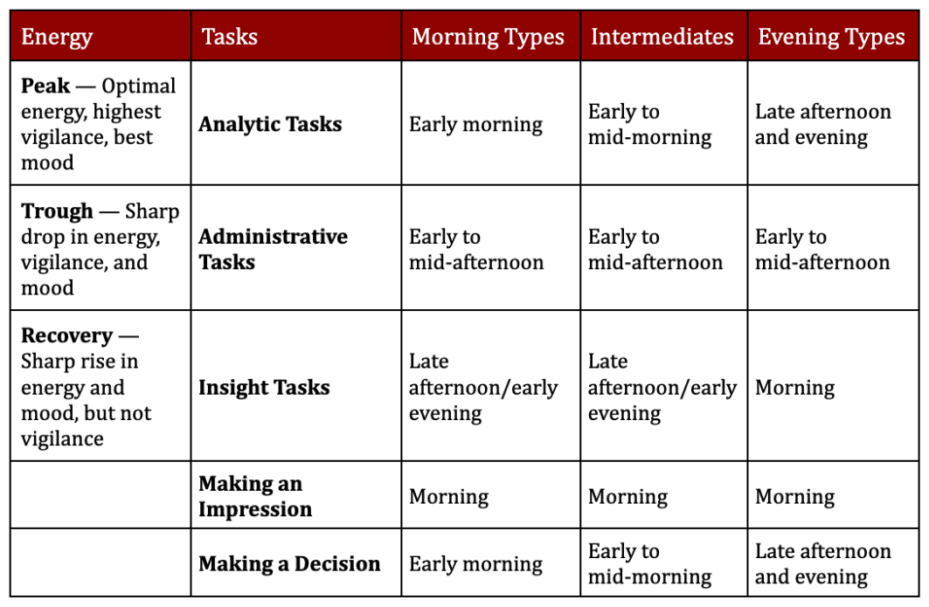
- Design Meetings and Tasks Around Natural Timing: Refer to the task-by-chronotype matrix (see Figure 3) to determine when different types of work should ideally happen. For example, schedule high-stakes decision-making during the team’s collective peak, reserve administrative tasks for low-energy windows, and time brainstorming or insight work for recovery periods. Even simple changes like shifting a meeting by an hour can lead to more meaningful participation.
- Use AI and Technology to Build Smarter, Chronotype-Aware Teams: Organizations could use AI to generate personalized schedules for individuals or teams. With each team member’s MEQ score and task objectives as inputs, a system could recommend when to meet, who should lead, and when to assign specific tasks. The goal is not to rigidly control time but to unlock better thinking by aligning tasks to energy patterns. The Wharton Neuroscience Initiative team has developed a web-based scheduling advisor that helps recommend optimal meeting and scheduling times for different activities, including both individual and team-based tasks.
- Pair Gen AI With Trough Times: During times when energy and focus naturally dip, typically early to mid-afternoon for most chronotypes, employees can lean on generative AI tools to assist with creative thinking or content generation. While human originality may be lower during these periods, AI can serve as a useful co-creator, helping people stay productive even when they’re not at their peak. “Time and task don’t always align,” says Tamarah Usher, Slalom senior director. “When energy dips and timing isn’t ideal, the smartest move is to adjust the tools. Generative AI is one of the most adaptable — helping sustain quality and creativity even when we’re not at our peak.”
These recommendations are just a starting point. The broader opportunity is cultural: to socialize conversations about energy and cognition; to elevate individuals’ and teams’ understanding; to strengthen team dynamics; to embrace timing as a strategic variable in how we plan, collaborate, and lead; and to advance organizational outcomes with cutting-edge insights and technology. Slalom is already implementing this research and looks forward to the continued learnings it will bring. Brad Jackson, Slalom CEO, says, “The future of work isn’t about headquarters, remote, or hybrid. It’s about reimagining how people and technology help each other think, create, and thrive. By blending neuroscience, AI, and human-centered design, we can build workplaces that bring out the best in people and the best in one another.”
“For decades, organizations have optimized for efficiency of systems,” says Platt. “The next frontier is optimizing for the human brain. When we align work with how our brains actually function, adaptability becomes a structural advantage, not just a cultural aspiration.”
By integrating chronotype awareness into how teams work and enhancing it with AI, organizations can unlock deeper creativity, stronger collaboration, and smarter performance. It’s not just about when we work — it’s about designing work that truly fits how people function at their best.