2025 Report
Shifting Trends in Cryptocurrency Confidence
Published on February 23, 2026
The Consumer Cryptocurrency Confidence Report 2025, the third in an annual series, finds non-linear trends in consumer confidence and trust in cryptocurrencies, with price volatility and increased detachment from the stock market. The survey-based initiative was led by Wharton marketing professors Cait Lamberton, David Reibstein and John Zhang, and Martin Paul Fritze of Ludwig Maximilians University of Munich.
The third annual report of the Consumer Cryptocurrency Confidence Index (c3i) reveals increased trust in centralized forces in a decentralized market.
What is c3i
The c3i is the first index specifically designed to capture consumers’ perceptions of and comfort with cryptocurrency. Modeled on the Michigan Consumer Sentiment Index, the survey covers a range of consumer perceptions and beliefs about crypto. For example, it tracks consumers’ perceptions of cryptocurrencies compared to other currencies, whether they perceive them as short-term speculations, or whether they see them as longer-term investments. It also tracks consumers’ willingness to use cryptocurrency in marketplace interactions such as payments and donations. Against the backdrop of the ongoing volatility in cryptocurrency prices, the index aims to track cryptocurrency confidence as a leading or lagging economic indicator.
Measuring Trust in Cryptocurrencies
Investor trust in cryptocurrencies hinges on multiple factors, including their sources of information, and their beliefs about the role of institutions in shaping crypto trends. Accordingly, the survey measured their degree of trust in (a) sources including tech industry leaders, researchers, celebrities, and professional sports figures; and (b) central institutions such as the Securities and Exchange Commission and the Federal Reserve to understand trends in cryptocurrencies. It also captured their perceptions on the role of other central authorities such as the U.S. president in influencing crypto prices.
How the Index is Calculated
The c3i index is calculated from survey responses on four parameters. These are respondents’ perceptions on (a) how they expect the value of cryptocurrency will change over the next year; (b) whether in the next 12 months cryptocurrencies will become more important or less important in business; (c) whether in the next five years cryptocurrencies will become more important, or less important for the economy as a whole; and (d) whether the present time is good or bad for people to buy cryptocurrencies. The respondents picked their answers on a scale of 1 to 7; the index was built using the average of those responses.
The Value of Capturing Consumer Sentiment
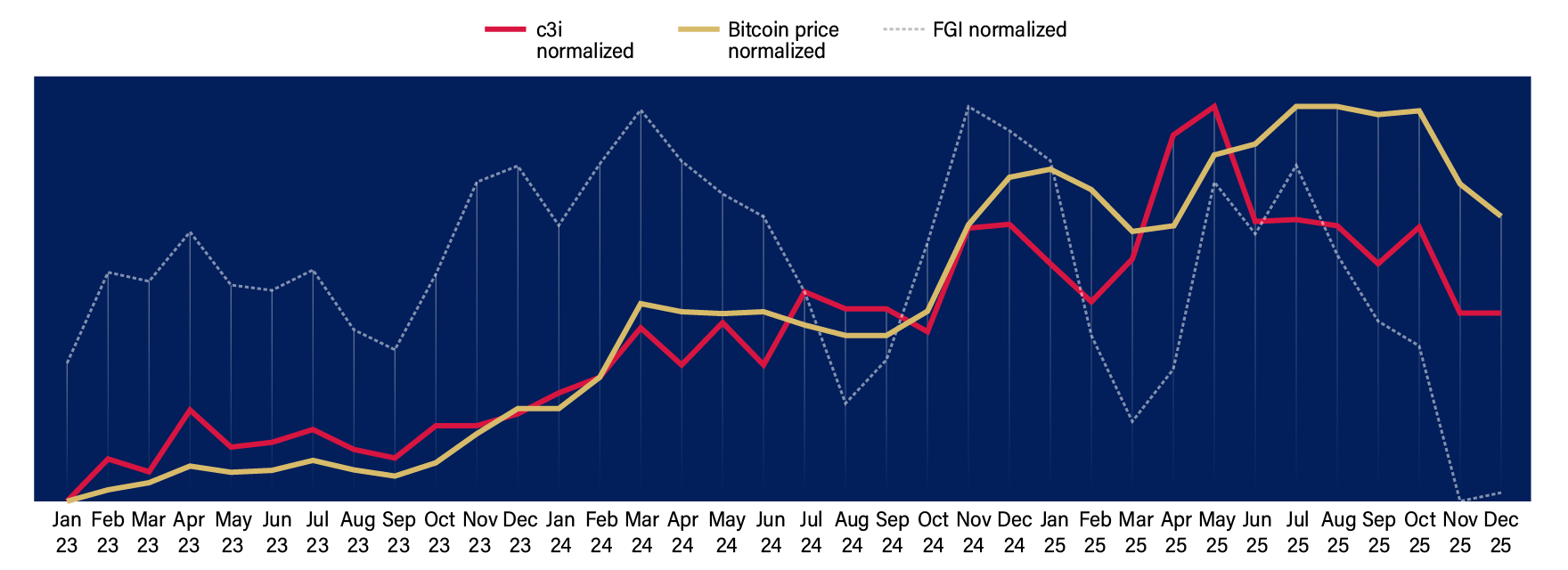
Analyses of the index against the major cryptocurrency Bitcoin show that although prices deviate above and below the c3i, they appear to revert toward a shared longitudinal trend, or trending in the same direction (see graph below).
But a different trend is visible when the c3i is benchmarked against another existing crypto index, the Fear & Greed Index for Bitcoin (FGI), which reflects crypto market sentiment through social media chatter, volatility, and market volume. The alignment is weaker between the FGI and Bitcoin prices, with larger and more frequent deviations in both directions.
This pattern highlights the importance of directly capturing consumer sentiment through the c3i to identify longitudinal dynamics beyond short-term volatility in cryptocurrency markets.
“Crypto may offer us the opportunity to understand new forms of trust, consumer behaviors that have not previously been examined, and the way that perceptions and uses for a new technology can evolve over time.”
—Cait Lamberton, Marketing Professor, The Wharton School
Who do consumers listen to when it comes to crypto?
Participants report the highest levels of trust in researchers, financial experts, and technology leaders. By contrast, actors and professional athletes—as well as politicians are among the least trusted sources of guidance.
To what extent do consumers believe the U.S. president has an influence on cryptocurrency prices?
On a scale of 1-7, average responses in the mid-to-high range suggest a relatively stable belief that the U.S. president influences cryptocurrency prices.
To what extent do consumers trust the SEC and the Federal Reserve?
In the early months of data collection, differences between nonowners and owners were small, with nonowners reporting greater trust in central institutions. However, this pattern reverses at several points in the time series, with crypto owners exhibiting higher trust in the SEC and the Federal Reserve than nonowners.
“Aside from single-shot surveys, we know very little about how consumers — the people who will ultimately determine whether crypto becomes a commonly-used tool in the market — view cryptocurrency, or how these perceptions change over time.”
—David Reibstein, Marketing Professor, The Wharton School
Key Takeaways
Three Years Later: A More Complicated Picture
The first c3i report documented a rising trend in confidence in cryptocurrencies despite ongoing volatility and lingering skepticism. Now, after three years of data collection, this picture appears more complicated.
While crypto prices still showed phases of sustained growth, there were also periods in which prices dropped sharply, falling below previously stable high levels.
At the same time, debates about the forces under which cryptocurrency prices may stabilize have intensified, particularly as crypto markets grow more detached from stock market trends and as developments such as Federal Reserve interest rate cuts, rising institutional participation, expanded investment opportunities, and political decisions directly or indirectly affect cryptocurrencies.
Trust in Political Authorities vs. Beliefs About Market Influence
This year’s findings point to an important distinction between trust in political authorities as sources of guidance and beliefs about their capacity to shape market outcomes.
While consumers do not appear to rely heavily on political actors when forming their opinions about cryptocurrencies — consistent with the decentralized ethos of crypto — they nonetheless believe that political authorities meaningfully influence crypto prices and market dynamics.
Decentralized Principles, Centralized Interventions
The report suggests that although cryptocurrencies are perceived to be fundamentally built on decentralized principles, consumer confidence may increasingly be shaped by interventions from centralized actors.
This paradox raises broader questions about how decentralization is understood and experienced by consumers, how power is perceived to be allocated within the crypto ecosystem, and what consumers expect from centralized forces operating within ostensibly decentralized markets.