The Skills Mismatch Economy: Insights from the Wharton-Accenture Skills Index
Published on January 9, 2026
AI is accelerating the shift from a role-based labor market to a skills-based economy, sharpening the relevance of the gap between what workers signal and what employers actually reward. To bring clarity to this transition, Wharton and Accenture developed the Wharton-Accenture Skills Index (WAsX), a recurring, empirical benchmark designed to measure which skills matter, which do not and how quickly the economy is shifting beneath us.

WAsX gives employers, workers and academic institutions a continuous, evidence-based view of how the talent economy is evolving.
The Signaling Gap
Oversupply of generalists – The labor market is operating in mismatch; workers promote one set of capabilities while employers pay for another.
Why it matters – Workers compete on “safe” signals that no longer differentiate talent. Employers lack, want and reward capabilities that workers under-signal.
Skills Have Price Tags
Skill value is role-specific, not universal – A skill correlated to increased pay in one role and/or industry can be correlated to reduced compensation in another.
Why it matters – WAsX challenges the long-standing assumption that some skills are always “high value,” as value is governed by the micro-economy of each role.
AI Is Redistributing Value
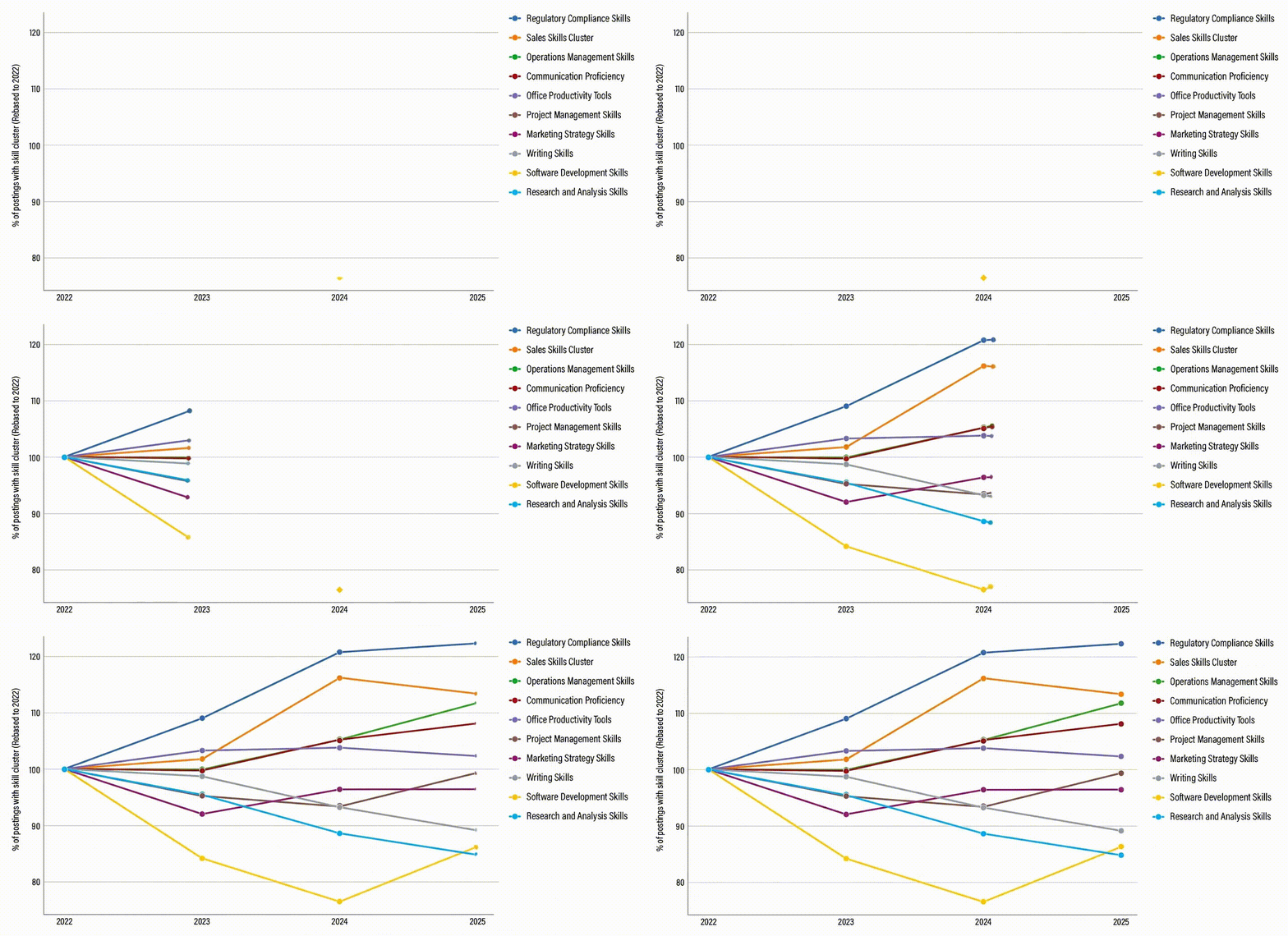
AI is reshaping what skills are worth – Gen AI is correlated with reduced demand for routine, structured cognitive work and increased demand for judgment, coordination, compliance, and domain expertise.
Why it matters – Instead of automating work away, AI is redistributing economic value across the skills spectrum.
Worker signals diverge from employer needs.
Common undersupplied skills signaled by workers.
Common oversupplied skills signaled by workers.
“The impact that generative AI will have on all jobs is in some sense immeasurable. We all have a responsibility to figure out how to leverage generative AI to do our jobs better, more efficiently, and with more impact. It is this set of skills — human plus AI — that we are educating our students on at Wharton.”

—Eric Bradlow, Vice Dean of AI & Analytics at Wharton
Skills have price tags — and value is highly contextual.
For example, signaling “strategic analysis” results in a:
“Across industries, advanced AI is fundamentally changing how work gets done, and which skills matter most. Leaders need more than intuition; they need evidence. The Wharton-Accenture Skills Index gives organizations a way to precisely measure where skills are falling behind, where they are accelerating, and what that means in real economic terms.”

—James Crowley, Global Products Industry Practices Chair at Accenture
AI is redistributing value.
Top 10 Skill Clusters: High AI Exposure
Key Takeaways
For Employers
- Diagnose skill surpluses and deficits to target hiring more precisely and direct reskilling investments where they matter most.
- Redesign jobs and allocate tasks more efficiently by clarifying which tasks robots can assume and which require human judgment, coordination, or domain expertise.
- Align pay with role-level skills that carry wage premiums, and avoid premiums for skills that are abundant or tangential.
For Employees
- Reframe a career as a portfolio of high-value skills by emphasizing concrete, role-relevant capabilities like technical depth, analytical fluency, and execution-level skills.
- Use AI to strengthen technical depth and advance into higher-value work.
- Prioritize upskilling choices and describe capabilities with greater precision by naming specific techniques, tools, or achievements.
For Educators
- Rebalance curricula away from generalist skills toward job-ready, economically scarce capabilities.
- Embed AI directly into how students learn technical skills using AI-supported simulations, practice environments, and feedback tools.
- Teach students to describe their skills with clarity and relevance—emphasizing specific techniques, tools, methods, and applied experiences rather than broad traits.
Download the Report