In this opinion piece, Wharton professors Howard Kunreuther and Robert Meyer look at what prevents homeowners from undertaking measures that will reduce greenhouse gas emissions, and how they can be convinced to do so. Kunreuther and Meyer are co-directors of the Wharton Risk Management and Decision Processes Center and are co-authors of The Ostrich Paradox: Why We Underprepare for Disasters.
The Biden administration has clearly indicated that climate change is a critically important issue on its agenda. Given the polarization of the country, a challenge that has not been adequately addressed is convincing property owners with varying political views to undertake measures, such as investing in solar panels, that will reduce greenhouse gas emissions.
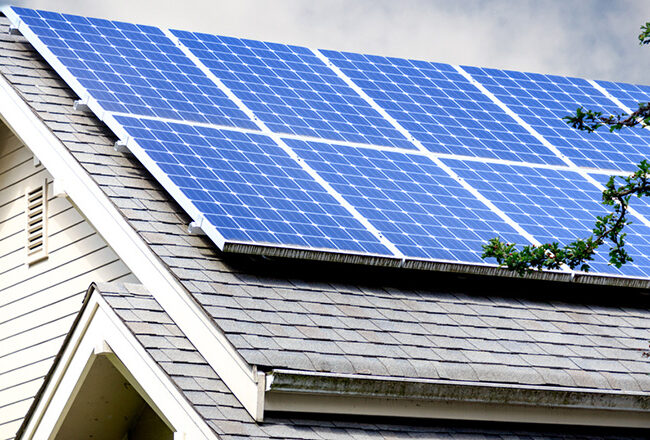
Despite a general recognition by most Americans that we need to pay attention to climate change, this concern has not led to action to address the problem. A December 2020 survey of voters in the U.S. by Yale University and George Mason University reveals that most respondents support policies that encourage the adoption of energy efficient measures – notably, solar panels on houses, schools and other buildings – to assist in reducing CO2 emissions. Nevertheless, according to an October 2019 survey by the Pew Research Center, only 6% of U.S. residents get their power from solar, even though it is financially attractive relative to fossil fuels for most homeowners, as indicated in a recent study by Wood Mackenzie.
Cognitive biases, such as myopia, inertia and herding, cause consumers to avoid investing in long-term measures. We can successfully address these biases with strategies that work with, rather than against, how people naturally make decisions, in concert with short-term economic incentives that meet households’ immediate needs. Here are a few ways that this can be accomplished by convincing homeowners to invest in solar power:
Due to myopia, many homeowners consider the high upfront costs of installing solar panels, without looking ahead to the savings from lower electricity costs in the years to come. Their short-term view leads them to believe that solar panels are not an attractive financial investment. A Power Purchase Agreement (PPA) can address this problem. In a PPA, a solar provider installs and maintains solar panels on a residential property free of charge. The homeowner buys power at a rate typically far lower than the retail rate charged by the local utility. Homeowners can also take advantage of the Solar Investment Tax Credit and apply a 26% credit to their federal income taxes on the installation cost of a solar panel system.
“We can successfully address these biases with strategies that work with, rather than against, how people naturally make decisions.”
Due to inertia, when people are unsure about the best course of action, there is a tendency to maintain the status quo, even when a more desirable alternative exists. Real estate agents can inform homeowners and potential buyers that houses with solar-energy systems sold for 4.1% more on average than comparable property without solar power, according to a study by Zillow in 2019. Building developers can make solar panels the default option by informing buyers that they will be installed on the roof of a new house unless the owners decide that they would prefer not to have them.
Due to herding – the tendency to imitate the behavior of friends and neighbors – one of the most cost-effective means of encouraging individuals to install solar panels is to create a social norm. If a homeowner sees solar panels on all their neighbors’ roofs, they may follow suit. Social norms can be incentivized via well-enforced regulations such as the one in California that requires new homes to have solar panels. The California Energy Commission estimates that the monthly mortgage payment on a house will increase by $40 a month but that the owner will save an average of $80 a month on electricity. Because the cost of the solar panels is included in the mortgage, the owner’s costs are effectively lowered from the moment they purchase the house.
States and communities can use other financial incentives to motivate homeowners to install solar panels such as a regret lottery, where each house in the region would be given a lottery ticket, but only those with solar panels would be eligible to win prizes. Homeowners who do not have solar panels would not win a prize even if their lottery numbers were drawn.
If political leaders recognize that cognitive biases are a principal reason that property owners are not utilizing solar panels, they can use these ideas to encourage and incentivize them to do so. To further enable the switch to solar energy, the federal government could provide financial resources to support research and development for innovations such as inexpensive storage batteries to deliver energy during times when there is no sunlight. Our hope is that homeowners and elected officials will see the light before it is too late.