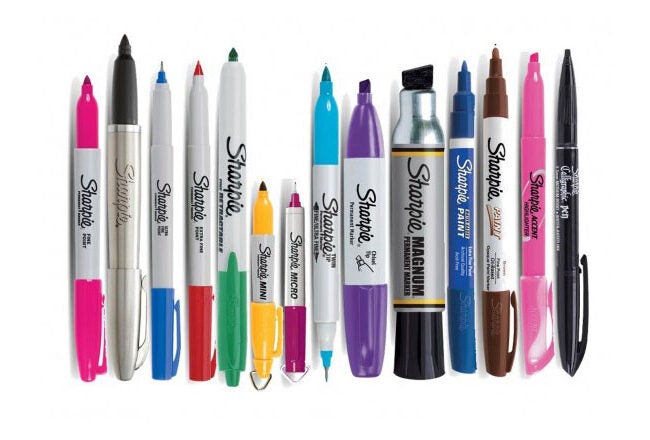
The Sharpie looks exactly the way it did in 1964, when the concept was so new that early ads had to explain to consumers exactly what permanent ink meant. (Early endorsements by Johnny Carson and Hugh Downs didn’t hurt.)
But the brand has done plenty of evolving since the early days — adding products specially designed to court the construction industry, the modern office, moms and, these days, teenagers.
“It’s not always about what you create, but about what you do about it,” Sharpie marketing director Janki Gambhir said during a case study on the brand, which is owned by Newell Rubbermaid, during the Retail and Consumer Goods Summit Tuesday in New York. The conference was organized by Knowledge at Wharton, Wharton’s jay H. Baker Retailing Center and Momentum Event Group.
The Sharpie is the subject of a lot of “consumer devotion,” Gambhir said, noting that some devotees can describe the exact scent that permeates the air once they un-click the cap, and would be quick to doubt the marker if the scent wasn’t exactly right.
Such enthusiasm has taken the brand in unexpected directions. For example, in the 1980s, the practice of getting autographs from celebrities and sports stars began to grow in popularity. The brand needed to come up with a way to equate Sharpie with “that magic, that fairytale feeling” inspired by encounters with personal heroes.
“We didn’t seed [the trend]; we didn’t create it; it just happened,” she noted. But the brand did get some unexpected help: In 2002, then San Francisco 49ers wide receiver Terrell Owens pulled a Sharpie out of his sock so he could sign a football after catching a touchdown pass. Sharpie later partnered with NASCAR driver Kurt Busch and started an “autographs for education” campaign in which it collected signatures from everyday people and donated supplies and money to schools in return.
Customers have also driven Sharpie’s latest shift — into the realm of self-expression. “We [asked customers] to ‘show us what you started with Sharpie'” via social media channels, Gambhir said. “We waited to see if it would work — and it did…. People were using Sharpies in more ways than we could possibly imagine.”
The millions of people using Sharpies to decorate cars, headphones, sneakers and more also prompted the company to focus on a new demographic — away from “mommy” and toward teenagers and young adults, specifically the 13-24 age group, Gambhir said.
Sharpie’s latest campaign, which debuts this week, is titled, “You can do anything with a Sharpie,” and the first commercial focuses squarely on an issue of great interest to the teen set: the prom proposal. The ad illustrates some of the 50 ways to get a “yes” response using the titular marker, including “a note,” “a better note” and “animal assistance.”
As Gambhir noted, “We wanted the ad to look like it was drawn with a Sharpie, because that reinforces what we’re trying to say with the campaign.”


