
Wharton's Barbara Kahn discusses her research on display design and perceptions of choice.

Whether it’s a gift for the holidays or a present to yourself, every purchase is the result of myriad choices on the part of the shopper — what color, which size, how big or how fast. While these are often conscious decisions, there are also numerous external factors at play every time you visit the mall or log on to Amazon. In a recent paper, Wharton marketing professor Barbara Kahn examines the impact of one of those potential influencers: Display design and how it affects our perceptions of variety. 

The research, “A ‘Wide’ Variety: Effects of Horizontal Versus Vertical Display on Assortment Processing, Perceived Variety and Choice,” was co-authored with Ohio State University professor Xiaoyan Deng, University of California, Davis professor H. Rao Unnava and Hyojin Lee, a professor at San Jose State University. 

Watch the video and check out the graphic below to learn more about how the effect works.
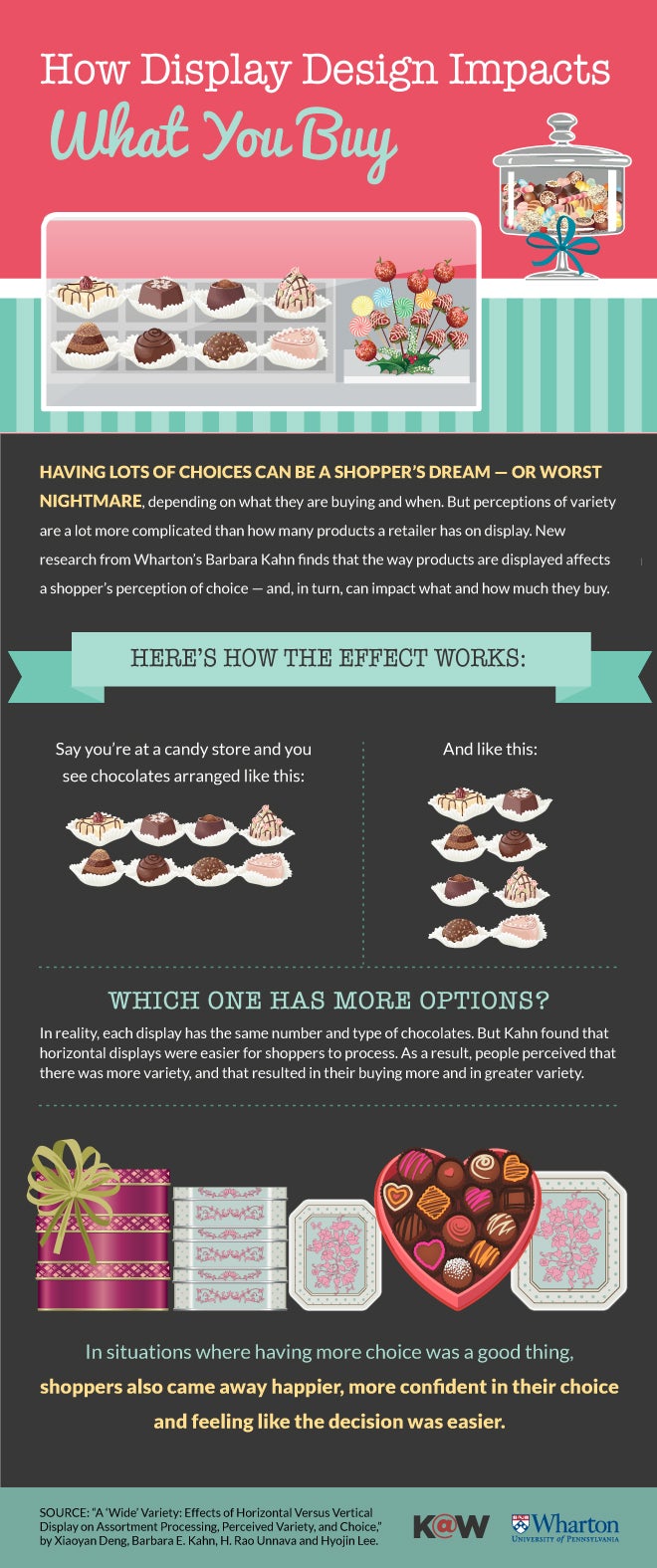
1200616_kahngraphic

Comments

New This Week

The image shows the emblem of the Social Security Administration, featuring an eagle with outstretched wings and the acronym "USA."

Why Social Security Is Essential to Measuring Wealth Inequality

March 10, 20264 min read

Wharton’s Sylvain Catherine explains how not accounting for Social Security can lead to inaccurate measurements of wealth inequality.

A red alarm clock showing 10:10 placed on a desk with a computer monitor, keyboard, and calculator. The scene represents time management or workplace productivity.

What’s Your Chronotype? How Brain Science Can Boost Performance

March 10, 202611 min read

A collaboration between the Wharton Neuroscience Initiative and Slalom explores how aligning work with individuals’ biological rhythms can help teams perform their best.

How Labor Market Power Shapes the Impact of Monetary Policy

March 10, 20266 min read

Firms with greater labor market power are less responsive to monetary policy in their hiring and wage decisions, new Wharton research shows.