Lays potato chips have been around for more than 75 years. That’s long enough to be considered a classic — but also a little dated.
To make the chips click (or crunch) with coveted millennial customers, parent company PepsiCo didn’t change the core product, “we changed the way that people looked at it,” said Ann Mukherjee, president of the company’s global snacks group and global insights division.
Along the way, the company also gained important insights about the way that modern customers think about brands, and how that impacts their purchase decisions in a rapidly changing marketplace.
“How do you take this unpredictability and give consumers what they’re looking for, which are often very unpredictable things?” Mukherjee asked during a presentation at this week’s Retail & Consumer Goods Executive Summit in New York. The conference was organized by Knowledge at Wharton, Wharton’s Baker Retailing Center and Momentum Event Group.
Thanks to digital technology, she noted, customers are no longer limited to their corner store for snack options — they can search for and buy just about anything from just about anywhere. It’s not enough to just create awareness of a brand: “If you’re not thinking all the way through to how to monetize it, you’re going to be in a lot of trouble,” Mukherjee added.
The Solution
PepsiCo’s solution to upping the cool factor of Lays was to put the power in the hands of the consumer — in 2012, it launched the first “Do Us a Flavor” campaign, asking people to come up with their ideal combination for the next flavor of Lays.
“There’s a huge movement in the U.S. around food, the passion of food, entertainment around food, food celebrities,” Mukherjee pointed out. “This wasn’t about Lays. We created tools that allowed people to celebrate their passion for food. Lays became a communication device for people to share about their daily lives.”
Anyone who had a chip idea in mind could visit Lays’ Facebook page, enter some information about their flavor and be rewarded with a shareable image of “their” bag of chips. The company teamed up with Facebook to turn the “like” button into a vote of “I’d Eat That.” Lays’ Facebook cover photo became a rotating billboard, which featured a new submission every few minutes.
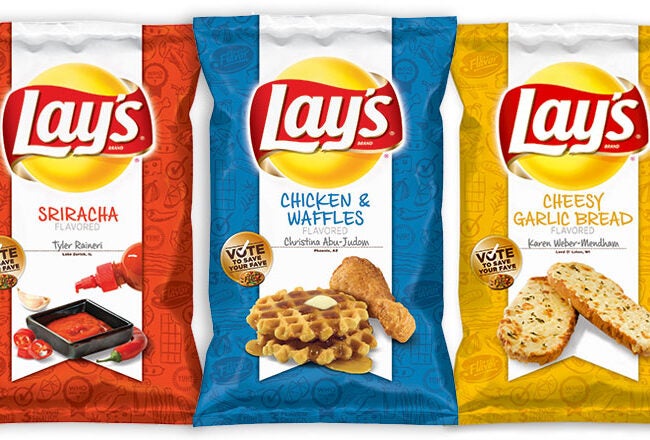
A panel of judges and campaign spokespeople — celebrity chef Michael Symon and actress Eva Longoria — helped narrow the contest to three finalist flavors: sriracha, cheesy garlic bread and chicken and waffles, and then opened the vote for a winner to the public.
“This wasn’t about Lays. We created tools that allowed people to celebrate their passion for food.”
PepsiCo’s first “choose a flavor” campaign was actually held several years ago in the U.K. and by the time the U.S. competition launched, the company had already done it in several countries. “The first time we did it [in the U.S.], we estimated we’d get a million votes; we got four million,” Mukherjee noted. “Last year, we did it for the second time and got over 14 million votes.”
When the inventory of the three finalist flavors arrived in stores, they were gone in two hours, Mukherjee said. “People were selling bags online for $35,” she added.
Why It Worked
The campaign, now in its third year, worked because PepsiCo knew the problem it was trying to solve, Mukherjee said.
“One-hit wonders don’t work. We don’t do fads for the sake of fads — it has to be tightly wired to the strategy of your brand,” she noted, adding that customization was key to making the contest appealing; so was the idea of letting consumers take ownership of sharing their chip creations or preferences.
“One-hit wonders don’t work. We don’t do fads for the sake of fads — it has to be tightly wired to the strategy of your brand.”
“The days of focus groups — it’s over,” she said. “It’s really about observing behavior. Big data comes together with granular understanding of human behavior.”
Mukherjee doesn’t see Lays abandoning “Do Us a Flavor” anytime soon. “We as marketers get bored before our customers do,” she noted. “We have strict metrics in terms of when we are beginning to see something peak…. If you think about it at scale, if you’re constantly reinventing, that’s really expensive. It’s more about how do you create a chassis and then be able to build on it year after year.”
Figuring out what works is all about longitudinal data, setting up experiments and learning over time, she noted. “There are some brands where traditional media has a big role,” Mukherjee said. “There are some brands where traditional media plays zero role. It’s all about what does the brand stand for, what does the brand stand with.”


