How the Best Countries of 2026 Made Their Grade
Published on June 16, 2026
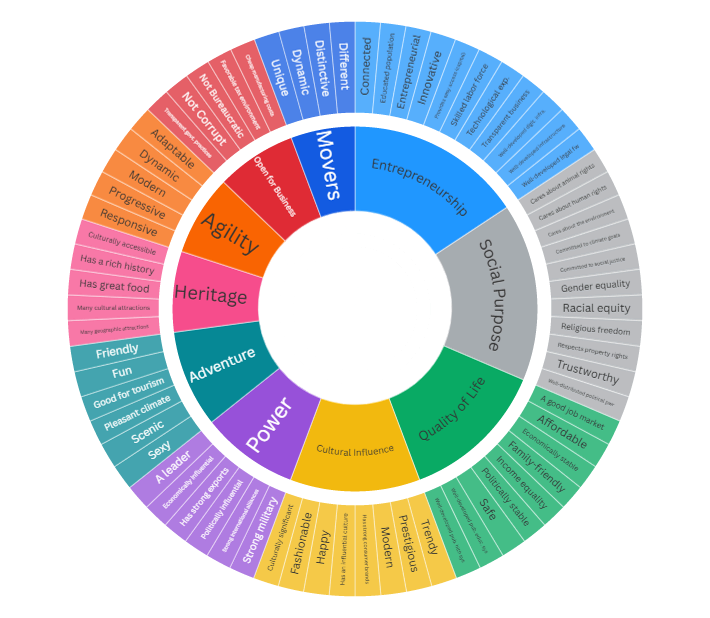
The image of a country, or in other words, its brand, determines how attractive it is to invest in, do business with, or travel to. A strong country brand also helps attract FDI and top talent. The newly released 2026 Best Countries Index ranks 85 countries on 73 attributes across categories including entrepreneurship, openness for business, quality of life, power, adventure and cultural influence. Wharton marketing professor David Reibstein led the survey-based report together with WPP and its brand analytics platform BAV.

Country Score Construction Framework
The 85 countries ranked account for 93% of global GDP and 78% of the world’s population. The rankings are based on a survey of perception of 15,131 adult respondents drawn from 33 countries, which are sample markets representing all regions of the world. Each country was scored on 73 attributes grouped into 10 thematic factors. These factors were weighted by correlating to 2025 gross domestic product at purchasing power per capita.
15,131 Respondents* from 33 Countries
▼
73 Attributes
▼
10 Factors
▼
Overall Country Score** and Rankings of 85 Countries
*The survey was conducted between late 2025 and early 2026.
**The overall country score is weighted by standardized correlations to GDP.
#1 Countries in Each Factor
Cultural Influence
Italy
Movers
United Arab Emirates
Quality of Life
Sweden
Adventure
Greece
Entre-preneurship
Germany
Open for Business
Luxembourg
Social Purpose
Finland
Agility
USA
Heritage
Italy
Power
USA
Attribute Highlight:
Who’s afraid – or not afraid – of AI?
More than 85% of Egypt, India, Saudi Arabia, Thailand, Nigeria and Vietnam seem to believe that the benefits of AI will outweigh the threats; China managed 84%. “The countries that are developing are not as threatened by AI,” said Reibstein. But that optimism towards AI was relatively subdued in the U.S. (64%), the U.K. (61%), Canada (56%), France (53%) and Australia (52%).
“Some of the countries that are bullish about AI are thinking AI is a salvation and that it will help make things better.”

—David Reibstein, Wharton Marketing Professor
Country Profile: China
China Makes Gains
China moved up two places to No. 14 and improved its ranking on several factors. China also dramatically improved its scores in the categories of “Social purpose” (#78 to #54), “Cares for the environment” (#85 to #48) and “Cares for climate goals” (#48 to #27). Compared to the U.S., China was perceived to be higher in the “Open for business” category (#35 v #72). It was also perceived to be more optimistic of the benefits of AI (84%) compared to the U.S. (63%).
“Overall, China has effectively improved its nation brand. Specifically, it has been able to improve its perceptions with regards to various ESG-tangential categories.”
—David Reibstein, Wharton Marketing Professor
Key Takeaways
How Brand Power Plays Out
More than 80% of the survey respondents agreed on these aspects of brands as they relate to countries:
- Consumer brands play an important role in defining a country’s culture.
- They feel proud of the consumer brands that represent their country abroad.
- The country a product is ‘made in’ impacts their preference to purchase it.
- They prefer brands made in their country, and
- They trust consumer brands to have a positive impact on society.
On the other hand, the respondents had divergent perceptions on these aspects:
- Brands that effectively use AI create a better, more personalized experience.
- The benefits of AI outweigh the threats.
- Government can be trusted to have a positive impact on society, and
- Traditional media outlets provide reliable and factual information.
Brands More Trustworthy Than Governments
An average of 82% of respondents had high trust in consumer brands “to have a positive impact on society,” compared to their trust in governments to deliver the same impact. That trust gap between brands and governments was stark in these countries: the U.S. (80% brands v 67% government), the U.K. (75% v 62%), Japan (77% v 59%) and France (65% v 48%). The gap was smaller in the case of Indonesia (98% v 87%), and India (92% v 89%).
Specifically as it relates to brands, more than 80% of respondents agreed on these statements:
- Consumer brands play an important role in defining a country’s culture.
- They actively choose to buy products from companies that have a purpose beyond making profit.
- They feel proud of the consumer brands that represent their country abroad.
- They prefer brands made in their country.
How to Improve Your Country Rank
One distinctive feature of the study is that the perceptions it measures are related to the GDP of a country – as a country improves its branding, its economy improves. Political instability affects FDI, which is one of the components of GDP. The country’s branding and economic growth may feed into each other, although with a lag.
A country that wants to improve its ranking must work to change the perceptions about it – with both real changes and better communications. “If the perceptions about your country are wrong, you need to change those perceptions, perhaps through better communications,” Reibstein said. “On the other hand, if the perceptions are not wrong, then it must fix the problem. If your infrastructure is not good and it’s perceived not to be good, you need to fix the infrastructure and then you need to communicate that it has improved.”
Reibstein cited the UAE as one that benefitted from investing in boosting its brand. The UAE jumped from 17th place in 2024 to 10th place in 2026. Dubai, one of the UAE’s emirates, invested in sprucing up its airport, hosted the World Expo in 2021-2022 , and set up several free trade zones that attracted foreign investment, he added.
About the Report: Why Study Country Brands?
Wharton marketing professor David Reibstein, an expert in both branding and metrics, was focused on company brands before he extended that concept to countries. Starting in 2016, he has studied – in partnership with WPP BAV – the image or brand of a country as seen by people from throughout the world and how that relates to GDP PPP of a country.
Reibstein reasoned that countries could extract economic gains from branding, just as consumer brands enable companies to sell more of their products and command premium pricing. At a country level, the tangible gains are in foreign direct investment, foreign trade and tourism. Strong branding could also help countries attract talent and innovation clusters, and help create conditions for a stronger currency.