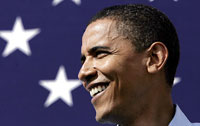
In little more than two months, President-elect Barack Obama will take the oath of office with virtually no time to bask in his historic accomplishment of being the first African American elected to the highest office in the land. His first term will begin amid what are arguably the most challenging days for a newly elected president since Franklin Roosevelt’s inauguration in 1933, during the depths of the Great Depression. Obama seeks to lead a nation mired in a worsening recession and burdened by the costs, both financial and human, of two wars and rising debt. The president-elect will need to confront these problems while delivering on the hopeful message he sold to his legion of supporters, weighing campaign promises to cut middle-class taxes and increase access to health care.
While considering what advice to give President-elect Obama as he prepares to take office, many Wharton faculty agree that his first 100 days in office — if not longer — will be dominated by the aftershocks from 2008’s credit crunch and the steep market declines on Wall Street. This month’s grim financial news — including an October jobless rate of 6.5%, the highest in 14 years, and double-digit declines in retail sales — makes it likely the new president will focus on stimulating the economy.
Given the array of problems that the Obama administration will confront, what should its priorities be? How much will the new president be able to spend on programs like alternative-fuels research or middle-income tax cuts without driving the federal deficit to unmanageable depths? And how will those short-term spending decisions affect his ability to deal with a long-term crisis — trillions of dollars in obligations to retiring Baby Boomers as they enroll in Medicare and Social Security? A growing number of commentators contend that Obama’s success in dealing with the economic slowdown will affect his policy decisions in other areas.
Wharton finance professor Jeremy Siegel, author of the book The Future for Investors, advises the Obama administration to move quickly on a large, one-time tax cut or rebate check program for low- and middle-income Americans as a way to keep the just-starting recession from worsening. While he also supports the large-scale infrastructure and alternative-energy programs that are under discussion as an economic stimulus, Siegel notes that those programs will take much longer to start up.
He offers another piece of advice to help Americans suffering from steep declines in the stock market: Dramatically increase the annual capital loss deduction limit on income taxes, which is currently capped at $3,000. He says that $10,000 might be a more appropriate level in the current economy. “Even $10,000 is not enough to compensate for the inflation of the last 20 years, but it’s one thing that would help.”
He would also like to require any banks receiving money from the government’s $700 billion package to continue making loans to their most creditworthy customers. But one plan he would urge the Obama administration to reject is the proposal to extend bailout monies to the troubled auto industry. Chapter 11 bankruptcy would allow Detroit to reorganize but not cause the massive job losses feared by some, he states. “Any bailout of the auto industry is really a bailout for the health benefits of the UAW [United Auto Workers]. That’s all it is.”
What about That Deficit?
Wharton finance professor Nicholas Souleles suggests that despite mounting concern about the government’s debt — which has grown from $5.7 trillion to nearly $10 trillion during the current Bush administration — Obama should not worry about increasing short-term deficits during a difficult recession. “Short-term, we have an urgent need to deal with the crisis, which will entail creating deficits within limits,” he notes. “That’s fine. It’s perfectly rational to run a deficit to get through hard times.” Policy makers in Washington seem to agree, with a lame duck session of Congress slated for this month to address an emergency economic stimulus package. The President-elect, at his first news conference, spoke of extending unemployment benefits and targeting aid to the deeply troubled auto industry.
Many experts believe that Obama — who spoke frequently during his campaign of the need to target infrastructure repair — should tackle that issue even more aggressively with an effort similar to Franklin Roosevelt’s Works Progress Administration, the New Deal-era program that created some 10 million jobs building everything from dams to football stadiums. This summer, state and local officials urged Washington to spend $1.6 trillion over a five-year period to rebuild infrastructure, especially roads and bridges. “He should think of the infrastructure insofar as we have identified current needs and current programs,” Souleles says, noting that any infrastructure effort should focus on programs already planned and in the pipeline. “One general problem with fiscal policy and spending is that often by the time you do what you set out to do, the recession has passed.”
Wharton legal studies and business ethics professor Eric W. Orts agrees with this approach. “In general, I think there’s going to be a need for some government spending to create kinds of targeted stimulus. There are not going to be checks for everybody,” as was the case with economic packages under President Bush in 2001 and again in 2008, says Orts, an Obama supporter and adviser. A likely project that Obama is already inclined to support, he notes, would be rebuilding America’s roads and bridges, which are in poor condition. “This is an area that fits with his campaign promise, and laying out some government funds will take the edge off a recession.”
Taxes Lowered and Raised
Energy policy, including the incoming president’s promise for a 10-year campaign to wean America off imported oil with a focus on renewable fuels, is another area where Wharton faculty agree Obama’s priorities could be closely tied to economic stimulus. “I think you’ll see more spending on alternative energy, with some kind of targeted spending subsidies,” says Orts. “One easy target would be green jobs for energy efficiency,” since an environmental jobs program would help address growing unemployment. So-called “green jobs” programs typically encompass a wide range of environmental tasks, including retrofitting buildings to make them more energy efficient.
Orts, along with other experts, also suggests using tax credits to encourage businesses and homeowners to spend more on renewable energy projects, such as installing solar heating panels. He says that any bailout of Detroit automakers — who recently requested $50 billion in federal loans to deal with their health care spending and liquidity problems — should be closely tied to a program of building more fuel-efficient cars.
The linkage between alternative energy and improving the economy could help Obama begin to address the thornier and costly long-term problem of tackling climate change during the early part of his term, notes Orts. He suggests that Obama ask Senator John McCain to lead a bipartisan effort to come up with climate change reform, given that McCain’s backing for a cap-and-trade system of reducing greenhouse gases is considered more business-friendly than Obama’s proposals and could improve the chances for a speedy compromise deal.
The economic slowdown clearly creates more difficult decisions for Obama in the area of taxes. He promised during his campaign to lower taxes on the middle class but raise them on families earning more than $250,000 a year, primarily by allowing the expiration in 2010 of the tax cuts for two higher-income brackets that were enacted under President Bush. The incoming president also wants to expand the earned income tax credit as a relief measure for the middle class; he would give those making less than $150,000 a $500 tax credit per person on the first $8,100 in income.
Philip M. Nichols, a Wharton professor of legal studies and business ethics, advises Obama to stick to his tax pledge and market it as another effective way to stimulate the economy. “The effect would be two-fold. It would increase the rate of spending by the middle class, but it would also increase the rate of saving by the middle class,” which would be a source of new capital that would encourage growth.
Wharton professor emeritus Gerald Faulhaber says that while he questions the wisdom of steep permanent tax cuts given the accumulated debt — including roughly $1 trillion in new borrowing linked to the recent financial rescue packages — he also agrees that short-term tax measures, similar in nature to the stimulus checks issued by the Bush administration, are worthy goals for the next six-to-12 months.
According to Kent Smetters, a Wharton professor of insurance and risk management, it is critical that the Obama administration avoid the temptation to pay for its tax breaks for the middle class by raising levies on corporations. During the campaign, Obama rebuffed a call from McCain to lower corporate taxes, saying that he planned to keep the current top rate at 35%. “The problem is that the United States already has one of the highest corporate tax rates in the world,” Smetters argues. He also doesn’t see the current corporate tax structure as “sustainable” when combined with the increased costs and regulatory burdens that medium-sized business must shoulder to comply with the 2002 Sarbanes-Oxley Act.
First, Do No Harm
Obama has promised to increase regulations on business, especially the financial sector, following the collapse of Lehman Brothers and several large banks. Several Wharton faculty members say they understand Obama’s political motivations, but advise a slow and cautious approach to imposing new restrictions on financial activities.
“Government could do a lot of harm if it gets involved in ways that aren’t perfect,” says Faulhaber, who served as chief economist for the Federal Communications Commission in 2000 and 2001. He compares regulation of business to a football game in which government needs to be a referee preventing egregious violations of the rules but should not act as a player, determining outcomes in what should be a free market. Faulhaber suggests that any regulatory effort have a narrow focus — such as on the clearing banks where credit activity has stalled — rather than a too-broad push that might punish transactions by hedge funds that, he says, shouldn’t bear the blame for the crisis. A bipartisan task force could carefully study the impact of any new rules before they are imposed.
“I’m very worried about [any] overreacting to this crisis,” agrees Smetters, who predicts that hasty action by the government would lead to a repeat of the activities that led to the passage of Sarbanes-Oxley, which he believes was poorly thought out and rushed into law. And while Obama should pay attention to the fiscal crisis, he should also remain mindful of the long-term federal debt and the looming dangers from expected shortfalls in Social Security and Medicare. A coalition of groups fighting for federal budget discipline has said the pending obligations for those programs and for Medicaid is $53 trillion, dwarfing the money pledged to rescue Wall Street.
“The amount the government will spend on the subprime issue is tiny,” while Medicare and Social Security is “20 or 30 times bigger than that problem,” says Smetters. He advises Obama to avoid any short-term fiscal solutions that would make the long-term debt crisis substantially worse. Neither Obama nor his rival McCain spoke much about the entitlement programs during the election season, although Obama has proposed increasing Social Security taxes on families earning more than $250,000 by 4% to help deal with projected future deficits.
As for health care reform, Wharton health care management professor Mark Pauly states that recent efforts to study the long-term Medicare funding problem have been too politicized and that a serious bipartisan effort — along the lines of the Alan Greenspan-chaired commission that developed a long-term solution for Social Security in 1983 — would be a welcome proposal from the Obama administration.
Pauly also believes that while the fiscal crisis would preclude any quick, major overhaul of the health care system, Obama could use the economic pain of the middle class as a rallying point for expanding the State Children’s Health Insurance Program, or SCHIP. Congress had failed in 2007 to expand SCHIP funding from $5 billion to $12 billion, but the program is up again for re-authorization in early 2009 and Obama will likely seek to expand it. The Obama administration, Pauly says, could also include mandates to the states that would advance a proposed model for his broader vision of national health care reform.
On the issue of trade, Nichols suggests that some of Obama’s more aggressive criticism of NAFTA — the North American Free Trade Agreement — was the result of political pressures in the declining industrial regions of Ohio and Western Pennsylvania. Nichols believes aggressive moves to renegotiate free trade agreements are not likely, and he notes that the new administration could improve trade relations with agricultural nations by reducing subsidies to farmers, which would also help cut the deficit.
Transition Period
Wharton management professor Heather Berry notes that in his campaign, Obama “offered tax cuts for working class families, expanded health care coverage and investing in clean energy technologies as priorities. However, he inherits a deficit that will make multiple priorities difficult to achieve…. Obama will need to figure out not only which programs and legislative initiatives are most important, but also how to pay for these programs. One issue that Obama will have to face in his first year is middle class tax cuts given that the Bush tax cuts were temporary and will need to be extended in 2009.”
Normally, Berry adds, “one of the earliest documents that offers specifics about a new president’s spending priorities is the annual budget that each president must present to Congress. Obama faces an unusual circumstance of a potential stimulus package that could be enacted prior to his inauguration. Given Congressional democratic support for stimulus spending, some of the less expensive measures Obama supports could be enacted before he takes office.”
As for how Obama plans to accomplish his many objectives, Berry would advise him to build a White House team that is oriented towards getting things done quickly. The hiring of Illinois congressman Rahm Emanuel — known for his assertiveness and ability to push through agendas — as his chief of staff is a positive move in that direction. Says Berry: “Obama’s picks to lead his transition team and staff show that he realizes the need for key Washington insiders to ensure a smoother transition and to work with Congress to enact his legislative priorities.”