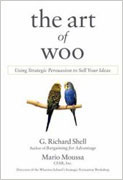
Former Chrysler chairman Lee Iacocca once noted, “You can have brilliant ideas; but if you can’t get them across, your ideas won’t get you anywhere.” In their new book, The Art of Woo: Using Strategic Persuasion to Sell Your Ideas, Wharton legal studies and business ethics professor G. Richard Shell and management consultant Mario Moussa provide a systematic approach to idea selling that addresses the problem Iacocca identified. As an example of effective persuasion, they tell the story of rock star Bono’s visit to then-Senator Jesse Helms’ Capitol Hill office to enlist his help in the global war against AIDS.
Bono had all the facts and figures at his fingertips, and launched into a detailed appeal based on this data. He was, in essence, speaking to Helms the same way he had recently spoken to executives and technical experts at the many foundations and corporations he had approached about this issue. But within a few minutes, Bono sensed that he was losing Helms’ attention, and he instinctively changed his pitch. Knowing that Helms was a deeply religious man (and drawing on his own born-again Christian values), Bono began speaking of Jesus Christ’s concern for the sick and poor. He argued that AIDS should be considered the 21st century equivalent of leprosy, an affliction cited in many Bible stories of the New Testament. Helms immediately sat up and began listening, and before the meeting was over had promised to be the Senate champion for Bono’s cause.
Examples such as this one illustrate what Shell and Moussa mean by “woo”: It’s the ability to “win others over” to your ideas without coercion, using relationship-based, emotionally intelligent persuasion. “The rock star Bono is superb at the art of woo because he understands what it takes to be a super-salesman, in the best sense of that term,” says Shell. “Here you have a rock star with tinted glasses and an elderly, conservative Southern senator. But when Bono had the good sense to switch from public policy talk about debt relief — what we call in our book the ‘rationality’ channel — to religious talk about poverty and disease — what we call the ‘vision’ channel — he touched Helms’ heart. He sold his idea and, in the process, created trust.”
The word “woo,” the authors note, has many meanings, but all of them relate to focusing on the person you are trying to persuade more than on your own needs and fears. “There is the obvious meaning related to courtship and romance,” says Shell, “but there is also the more general idea of wooing people to seek their support. In addition, Marcus Buckingham and Donald Clifton have recently used the word ‘woo’ in their books to describe the ability to easily establish rapport with many different people.” However “woo” may be defined, the authors argue that effectively selling ideas — using persuasion rather than force — is one of the most important skills that everyone from CEOs and entrepreneurs to team leaders and mid-level managers need to learn if they want to be effective in their organizations.
The Spirit of St. Louis
The Art of Woo presents a simple, four-step approach to the idea-selling process. First, persuaders need to polish their ideas and survey the social networks that will lead them to decision makers. To illustrate this step, Shell and Moussa recount how an unknown mail pilot named Charles Lindbergh turned his dream of being the first person to fly nonstop across the Atlantic into a reality. His idea was radical: He would make the crossing in a single-engine plane flying without a co-pilot or even a life raft. The idea was followed by his campaign to overcome people’s disbelief that such a venture could ever work and to win over supporters in his hometown of St. Louis. Lindbergh started with contacts at the local airport who could see why his plan made sense and eventually worked his way up to the most influential businessmen in the city, using each person along the way to leverage an interview with the next.
The second stage of the Woo process is confronting what Shell and Moussa call “the five barriers” — the five most common obstacles that can sink ideas before they get started. These include unreceptive beliefs, conflicting interests, negative relationships, a lack of credibility and failing to adjust one’s communication mode to suit a particular audience or situation. Great persuaders throughout history have shared with Bono an instinct for overcoming this last barrier. For example, when Napoleon was a young officer at the siege of Toulon, he set up an artillery battery in such a dangerous location that his superiors thought he would never get troops to man it. They would have been right had Napoleon relied on the conventional “authority channel” and issued threats and orders to get his way. Instead, he demonstrated his social intelligence by switching to the visionary channel and creating a large placard that was placed next to the cannons. It read: “The Battery of the Men without Fear.” The position was manned night and day.
Similarly, when Nelson Mandela was incarcerated on the notorious Robben Island in South Africa, he managed to obtain blankets and other necessities for his fellow prisoners by foregoing the expected high-minded appeals to politics and human rights. He worked instead on the relationship persuasion channel. By learning the guards’ Afrikaans language and reading their literature, Mandela earned their respect and won them over to his idea of fair treatment — even as he continued to face hostility from the officials who ran the prison.
The third stage is to pitch your idea in a compelling way. Shell and Moussa note that at Google, employees selling ideas to upper management are given a challenge: to distill their business concepts into short, punchy presentations that get right to the essence of what they are proposing. This discipline forces them to figure out exactly what problem their idea addresses, how their idea will solve it and why their idea is better than both the status quo and available alternatives. The authors offer a template for pitching ideas in this format and give examples of distinct ways one can personalize an idea to make it memorable and distinctive.
The final stage of Woo is to secure both individual and organizational commitments. “One of the most common mistakes people make in selling ideas,” says Shell, “is to think that their job is finished once they succeed in getting someone to say ‘yes’ to their proposal. That’s only the beginning. Research shows that in most organizations, a minimum of eight people will need to sign off on even simple ideas. The number goes up from there. So after you move the individual, you also have to move the organization.”
Shell and Moussa use a number of cases from business history to illustrate this point. For example, they tell the story of Charles F. Kettering, a brilliant inventor and engineer from the 1930s whom many consider an equal of Thomas Edison. Kettering invented such things as the automatic transmission and safety plate glass, but one of his best ideas — the air-cooled automobile engine — sat on the shelf for decades until the Volkswagen Beetle incorporated it. Kettering convinced Alfred Sloan, GM’s top executive, that producing the air-cooled engine was a good idea, and the company’s executive committee gave the go-ahead to make a limited number of cars with the prototype. But instead of following the idea through, Kettering went back to his lab to concentrate on the technical aspects of the project. The committee handed the production assignment to the Chevrolet division, whose top managers had never been brought into the persuasion process. They let the idea languish and it was eventually abandoned. “Kettering made a fundamental mistake: He didn’t follow up and keep the pressure on,” Shell notes. “He didn’t do the political coalition-building needed to implement his idea.”
Andy Grove’s ‘Constructive Confrontation’
Individual personality plays a key role in how you influence others, Shell adds. The book therefore includes two personalized “diagnostic” tests that readers can take to discover their persuasion strengths and weaknesses. One of the diagnostics is the “Six Channels Survey,” which is designed to help people learn which of the key channels of influence they feel compelled to use most often at work and which they would prefer to use if given a choice. These channels include Authority, Rationality, Vision, Relationships, Interests and Politics. The idea is to help readers understand both how these six channels work and when they should adjust their pitch — as Bono did with Senator Helms and Mandela did on Robben Island — to appeal to different kinds of audiences.
A second self-administered test, the Persuasion Styles Assessment, helps readers determine the degrees of assertiveness and natural social intelligence they bring to the idea-selling process. The authors point out that there is no one “correct” style of persuasion; rather, the key is being self-aware so you know how you perform and how others will perceive you.
For example, Shell and Moussa illustrate the “Driver” style (a highly assertive type who gives only limited attention to the social environment) by examining how Intel CEO Andy Grove managed the persuasion process at Intel during his years as that company’s leader. Labeled the “screamer,” Grove could be intimidating to people who didn’t know him well. But he was also willing to listen if people stood up to him and matched his passion. To facilitate communication, Grove instituted what he called a culture of “constructive confrontation” that freed everyone to be as blunt and assertive as he was. The result was a high-stress environment, but one in which everyone could speak their minds.
The Art of Woo goes on to describe four other distinctive styles with examples drawn from business history. Banker J. P. Morgan is given as the model for the Commander (a Grove-like person who has a quieter demeanor), John D. Rockefeller exemplifies the Chess Player (a quieter person who attends strategically to the social environment), Andrew Carnegie’s life provides the example for the Promoter style (a gregarious type who uses high levels of social intelligence), and Sam Walton is the model for the style that strikes the balance among all the others — the Advocate.
Three Typical Mistakes
Both Shell and Moussa have wide experience in the area of negotiations. Shell is director of Wharton Executive Education’s Negotiation Workshop and author of Bargaining for Advantage: Negotiation Strategies for Reasonable People. Moussa teaches executive education courses on negotiation and organizational change and is head of the Negotiation Practice Group at management consulting firm CFAR (the Center for Applied Research). This year, Shell and Moussa launched a new Wharton Executive Education program called the Strategic Persuasion Workshop.
The idea for the book arose from the comments of executive education participants who frequently spoke about internal negotiation problems they were facing in their companies. These conversations gave the authors the idea to “talk about persuasion inside organizations, with a focus on selling ideas,” says Shell. “We had a laser beam into the crisis moment when you’re sitting at the table and you’ve got an idea or an initiative or a program, and you’re trying to get buy-in from a decision maker. From there, we built out the strategic process that can prepare you for that moment in the best possible way. By doing that, we were able to identify the key personality traits that great persuaders share and develop the diagnostic surveys to help people gain insights into their own styles and approaches.”
Asked what the top three mistakes are that people make in selling ideas, Shell notes that the number one-error is “egocentric bias,” or “focusing on yourself instead of your audience. People assume that the person they are trying to sell on their idea is just like them, that he or she has the same primary goals and frame of reference, and that what they are talking about is important to the other side. But other people may not care at all about what is important to you…. It’s a killer assumption.”
A second mistake is the belief that there are no systematic ways to persuade people to accept an idea. “A lot of people just wing it, thinking they can count on their own experience and instinctive powers of persuasion to carry the day,” says Shell. “But in fact, you do need a strategy. That is what this book is about.”
The third most common error is to forget about organizational politics, as Charles Kettering did at General Motors. “Whenever a new idea might affect resources, power, control or turf,” Shell says, “politics will be part of the problem at the implementation stage. You need to prepare an idea-selling campaign, not just a presentation.”
The authors suggest that people working in any group — from the largest Fortune 500 company to an entrepreneurial startup — can benefit from improving their skills at the art of persuasion. As Shell notes: “Influencing others in an organization to accept and act on your ideas is a challenge that never goes away.”